For decades, Alzheimer's research has treated amyloid plaques and tau tangles as inevitable harbingers of cognitive decline. New spatial genomics data from Nature Medicine challenge that assumption by revealing that the brain's immune cells — microglia — don't simply react uniformly to pathology; they execute distinct, sequentially ordered programs whose trajectory may separate those who develop dementia from those who don't.
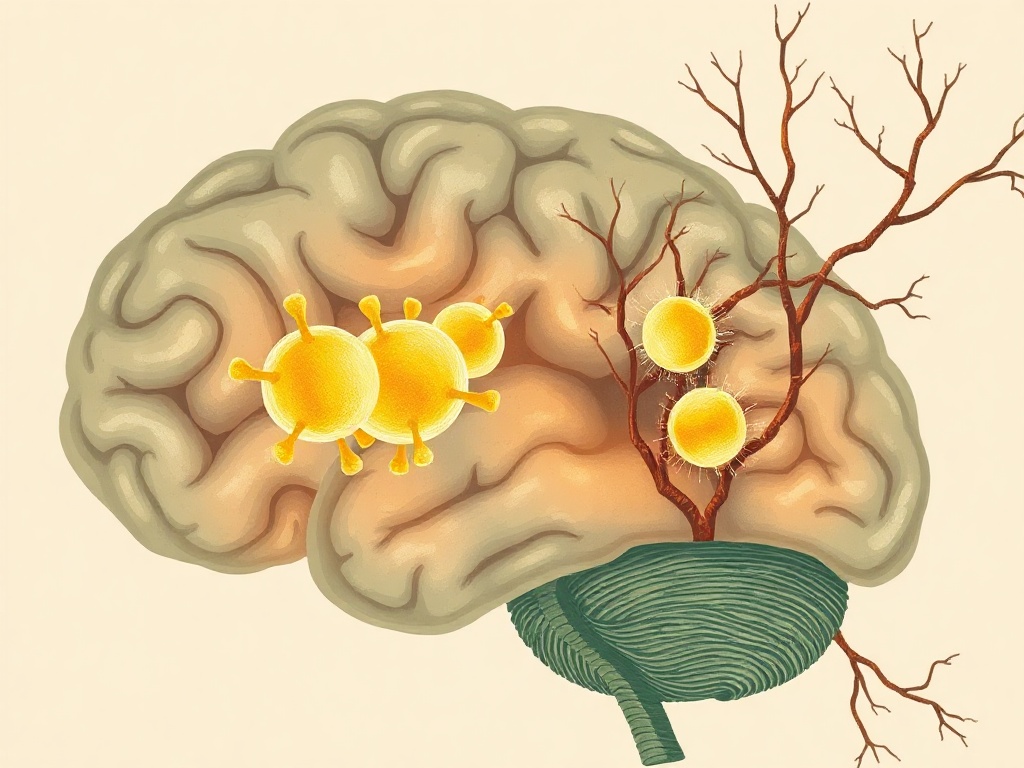
Using spatial transcriptomics and single-nucleus RNA sequencing applied to superior frontal cortex tissue from three groups — octogenarians with dementia, octogenarians who remained cognitively intact despite amyloid accumulation, and centenarians with comparable amyloid burdens — researchers mapped six discrete tissue domains that form a spatial continuum of Alzheimer's pathology. The critical inflection point occurs where amyloid-driven inflammatory microglial activity gives way to tau-associated programs. This transition is mediated by a shift between two microglial phenotypes: early plaque-induced gene (PIG) microglia, characterized by inflammatory signaling, and late PIG microglia, which adopt antigen-presenting functions. Crucially, cognitively resilient octogenarians largely lacked late PIG activation, while centenarians showed late PIG engagement that appeared functionally decoupled from tau accumulation — suggesting at least two biologically distinct routes to resilience.
This work is methodologically significant: combining spatial transcriptomics with single-nucleus sequencing in human postmortem tissue from well-characterized extreme-age cohorts provides mechanistic resolution that mouse models have consistently failed to deliver. The identification of microglia as the pivotal cell type at the amyloid-tau interface aligns with — and substantially extends — earlier GWAS findings implicating microglial genes like TREM2 in Alzheimer's risk. The divergence between octogenarian and centenarian resilience patterns is particularly provocative, implying that protective mechanisms are not monolithic and may need to be targeted differently across age strata. Limitations include postmortem tissue constraints, inability to establish causal directionality, and the need for replication in larger and more diverse cohorts. Still, repositioning microglial state transitions as therapeutic targets rather than mere bystanders represents a meaningful conceptual advance.