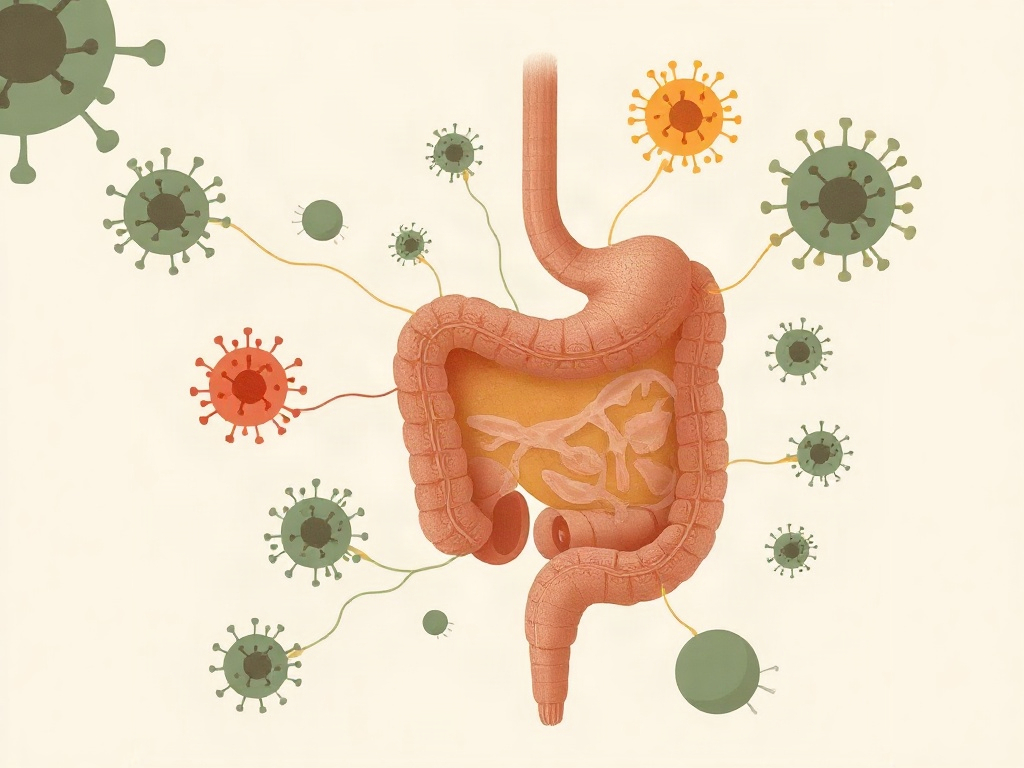
What if a root driver of tissue aging isn't a broken gene but a disrupted chemical dialogue between the gut and peripheral organs? New evidence points to bile acid redistribution as an underappreciated accelerant of cellular senescence — and crucially, one that may be chemically reversible. This reframes aging not merely as cellular wear-and-tear but as a systemic signaling failure with a discrete molecular address.
Using targeted bile acid metabolomics in young versus middle-aged mice, the investigators tracked taurine-conjugated bile acids — specifically T-α-MCA and T-ω-MCA — across intestinal and peripheral compartments. With age, these molecules become sequestered in the gut lumen, creating a spatial mismatch: peripheral tissues including lungs, skin, and lymph nodes are progressively depleted of compounds that normally restrain Farnesoid X Receptor (FXR) activity. The resulting chronic FXR hyperactivation in peripheral tissue disrupts downstream Retinoic Acid Receptor alpha (RARα) signaling, accelerating senescent cell accumulation. More strikingly, FXR overactivation upregulates PD-L1 and PD-L2 immune checkpoints on senescent cells, enabling them to evade immune clearance — a mechanism better known from tumor immunology. Dietary bile acid sequestration via cholestyramine reversed these phenotypes: senescent burden declined, checkpoint expression fell, and multi-organ transcriptomics shifted toward a younger profile.
This finding sits at the intersection of two rapidly evolving fields — senolytic biology and bile acid signaling — and the mechanistic bridge it proposes is genuinely novel. Prior work established that the gut microbiome shapes bile acid pools and that FXR governs metabolic homeostasis, but the direct link from enterohepatic compartmentalization to PD-L1-mediated senescent immune evasion has not been demonstrated before. The cholestyramine intervention adds a causal anchor that pure metabolomics studies lack. Key limitations: this remains an animal study, and mouse bile acid physiology diverges meaningfully from human profiles. Translation requires human metabolomic validation and assessment of whether gut-sequestered FXR antagonists can be safely redistributed systemically without disrupting lipid absorption. If the axis holds in humans, it raises intriguing questions about whether existing cholesterol-management agents could be repurposed as indirect senolytics. Incremental? No — this is a mechanistically substantive advance worth watching closely.