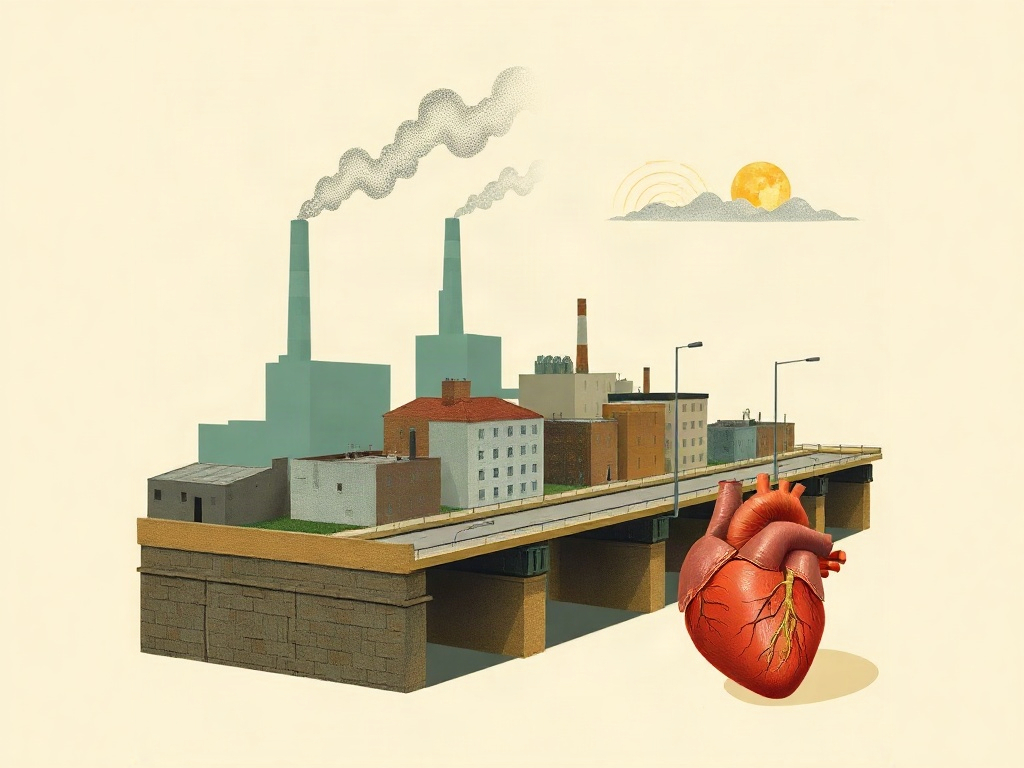
Cardiovascular disease guidelines have long focused on cholesterol, blood pressure, and lifestyle — but a sweeping new consensus from one of Europe's most authoritative cardiology bodies argues that the environment itself is an underappreciated co-conspirator, one that operates silently and cumulatively across a lifetime.
This European Society of Cardiology consensus review synthesizes evidence across five environmental domains: air pollution, noise, heat, chemical contamination, and light pollution. Critically, it finds that each of these stressors elevates cardiovascular risk — including incidence of coronary artery disease, stroke, heart failure, arrhythmias, and hypertension — even at exposure levels that current regulatory frameworks deem acceptable. The document introduces the "exposome" concept as a unifying lens: rather than treating each pollutant in isolation, the framework accounts for the cumulative, lifelong burden of overlapping environmental hazards. Shared pathophysiological mechanisms — oxidative stress, systemic inflammation, endothelial dysfunction, and circadian disruption — appear to link otherwise disparate exposures.
What makes this review analytically consequential is its explicit acknowledgment that clinical cardiology has systematically underweighted environmental contributors. Most cardiovascular risk calculators omit residential noise exposure, ambient particulate matter levels, or proximity to light-polluted urban environments, despite growing epidemiological evidence tying each to measurable outcomes. The exposome framing is particularly forward-looking: it invites gene-environment interaction research and high-resolution exposure mapping that could eventually personalize environmental risk assessment the way polygenic scores are beginning to personalize genetic risk. The review's attention to vulnerable populations — children, elderly adults, those with pre-existing cardiovascular conditions, and socioeconomically disadvantaged communities — also underscores that environmental cardiovascular burden is not uniformly distributed. This is a broad consensus statement rather than a randomized trial, so causal inference remains partially constrained by observational methodology. Still, its scope and institutional weight make it a potentially practice-shifting document, particularly for clinicians working in urban or industrialized settings where environmental exposures are highest.