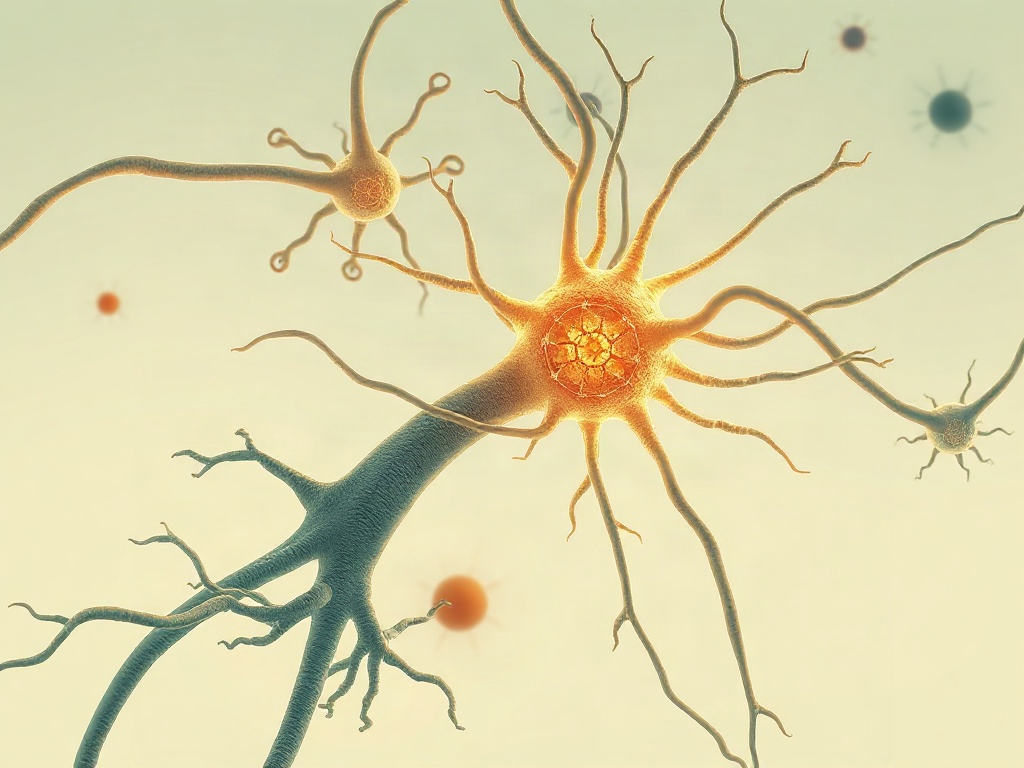
For decades, Alzheimer's research has centered on amyloid plaques and tau tangles as the primary drivers of neurodegeneration. This Nature study challenges that hierarchy by identifying a receptor tyrosine kinase — ERBB4 — ectopically expressed in excitatory neurons as a potentially upstream orchestrator of the disease's defining features, including synaptic loss, reactive gliosis, and cognitive decline.
Using single-nucleus RNA sequencing in AD mouse models, researchers identified a previously uncharacterized population they termed early-responsive excitatory neurons (EREN), distinguished by aberrant expression of Erb-B2 receptor tyrosine kinase 4 (ERBB4) — a gene normally confined to inhibitory interneurons in the mature brain. Critically, selective deletion of Erbb4 in excitatory neurons eliminated not only synaptic pathology and aberrant network activity, but also amyloid plaque deposition and cognitive deficits. In the reverse experiment, overexpressing ERBB4 in healthy excitatory neurons reproduced these AD-like phenotypes even in the absence of amyloid. The mechanistic link traced through mTOR signaling downstream of ERBB4, and human AD transcriptomic data supported the model's translational relevance.
This finding carries substantial implications for how researchers conceptualize early Alzheimer's progression. Conventional frameworks treat amyloid accumulation as the initiating insult, with neuroinflammation and synapse loss as downstream consequences. Here, excitatory neuronal ERBB4 appears both necessary and sufficient to induce hallmark pathology, positioning it upstream of — or at least parallel to — amyloid in the disease cascade. The mTOR connection is particularly noteworthy given rapamycin's established longevity and neuroprotective profile in animal models. Limitations include the predominance of mouse model data; while human transcriptomic mediation analyses are included, causal claims in humans remain inferential. Whether pharmacological ERBB4 inhibition in neurons is achievable without disrupting cardiac or inhibitory-neuron ERBB4 signaling remains an open translational question. If replicated, this represents a potentially paradigm-shifting reframing of Alzheimer's neural circuitry origin story.