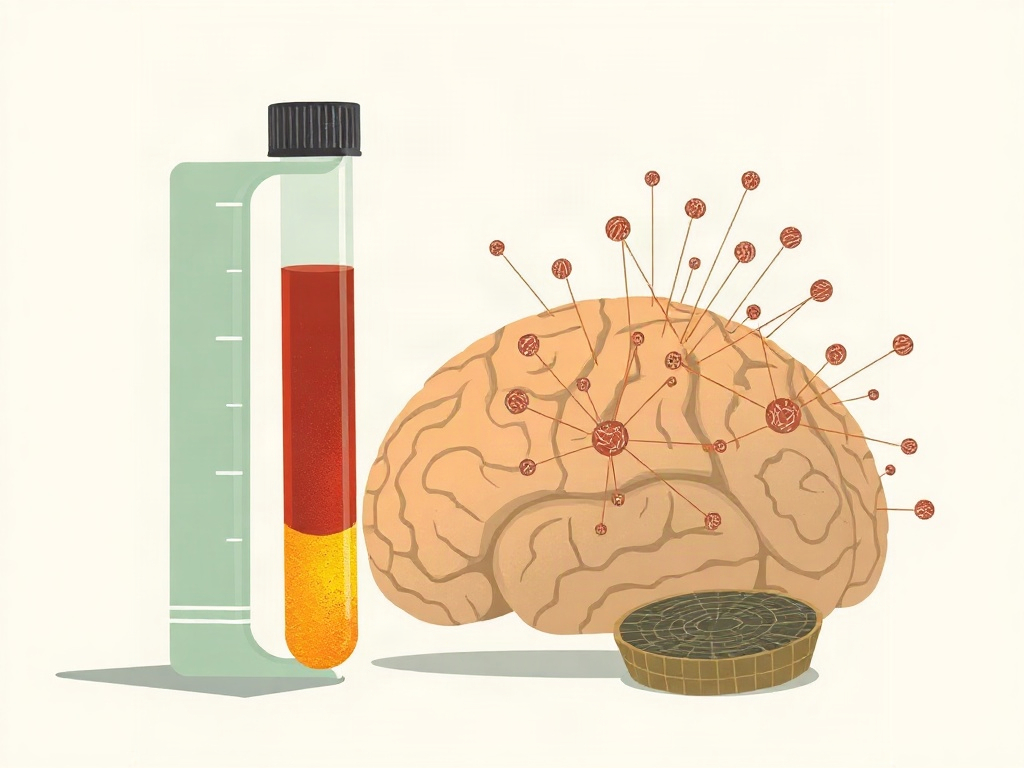
Most dementia risk scores focus on lifestyle factors and genetics measured close to diagnosis — but a growing body of evidence suggests the biological seeds of cognitive decline are sown decades earlier. A stress-response protein measurable from a routine blood draw may now offer a 25-year early-warning signal, and crucially, the research suggests this protein isn't just a passive bystander but an active driver of brain deterioration.
The study examined circulating levels of Growth Differentiation Factor 15 (GDF15), a cytokine released in response to cellular stress, mitochondrial dysfunction, and inflammation. Across multiple independent cohorts, elevated midlife plasma GDF15 was associated with significantly greater dementia risk across follow-up windows spanning 15 to 25 years. The association was notably stronger for vascular dementia than for Alzheimer's disease specifically. Two-sample Mendelian randomization — a method that leverages genetic variants to approximate causal inference — supported a mechanistic rather than merely associative role for GDF15 in Alzheimer's disease and related dementias. Mechanistically, elevated GDF15 linked to cerebral small vessel disease, neurodegeneration markers, phosphorylated tau accumulation, and a cerebrospinal fluid proteomic signature reflecting neuroimmune activation. In vitro exposure of myeloid immune cells to recombinant GDF15 shifted gene expression in pathways — particularly interferon and antiviral signaling — that independently predicted dementia risk.
GDF15 has long attracted interest in longevity research as a marker of mitochondrial stress and aging, but its neurological implications have been underexplored. This study is notable for its use of Mendelian randomization to push beyond correlation toward causality, though that technique has its own assumptions and cannot fully substitute for a randomized trial. The strong vascular dementia signal is clinically meaningful: vascular contributions to cognitive impairment are often considered more preventable than Alzheimer's pathology, raising the possibility that GDF15 could one day anchor risk-stratification tools that trigger earlier lifestyle or therapeutic interventions. The neuroimmune mechanism, specifically interferon pathway dysregulation in microglia-lineage cells, aligns with emerging understanding of neuroinflammation's central role in dementia progression. Whether GDF15 suppression could be therapeutic remains entirely open.