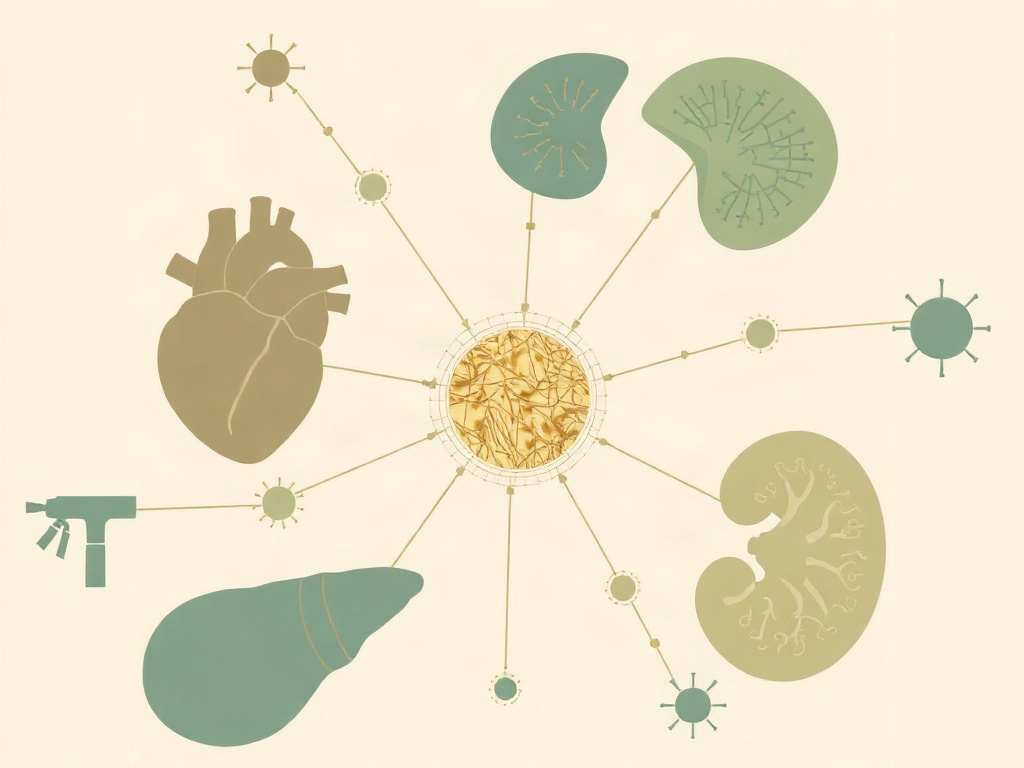
Understanding why some organs age faster than others — and whether that acceleration predicts disease — is one of the central puzzles of longevity science. A new computational framework published in Nature Aging attempts to answer that question at scale, by reading the microscopic architecture of human tissue rather than relying on the imprecise proxy of chronological age.
Yadav and colleagues built an image-based aging quantification system trained entirely without chronological age as a supervisory signal — a deliberate methodological choice that sidesteps circular reasoning common in clock-building. Analyzing a large dataset of human histology images spanning multiple organ types, the framework assigns structural aging scores to individual tissues. The results reveal that organs follow distinct aging trajectories: some accelerate early, others plateau, and some show coordinated deterioration with anatomically distant tissues. Critically, accelerated structural aging in specific organs was linked to identifiable molecular pathways, heritable genetic variants, and downstream pathological states, suggesting the scores carry biological rather than merely statistical meaning.
This work sits within a rapidly expanding field of biological age estimation that includes epigenetic clocks (Horvath, PhenoAge, DunedinPACE), proteomic clocks, and metabolomic approaches. What distinguishes the histological angle is its direct readout of tissue architecture — the physical substrate of function — rather than upstream molecular signals whose tissue-level consequences are often inferred. The organ-specific trajectories challenge a still-prevalent assumption that aging is a uniform systemic process; instead, this data supports a mosaic model where biological age is genuinely tissue-dependent. Key limitations worth noting: histology datasets, however large, are predominantly drawn from clinical or autopsy contexts, potentially biasing toward pathology. The causal direction between structural aging scores and disease outcomes remains to be established in prospective cohorts. Nonetheless, linking image-derived aging to genetic architecture opens a compelling path toward identifying druggable targets. This is an incrementally paradigm-nudging finding — not overturning the field, but materially advancing the granularity with which aging can be measured and eventually modulated.