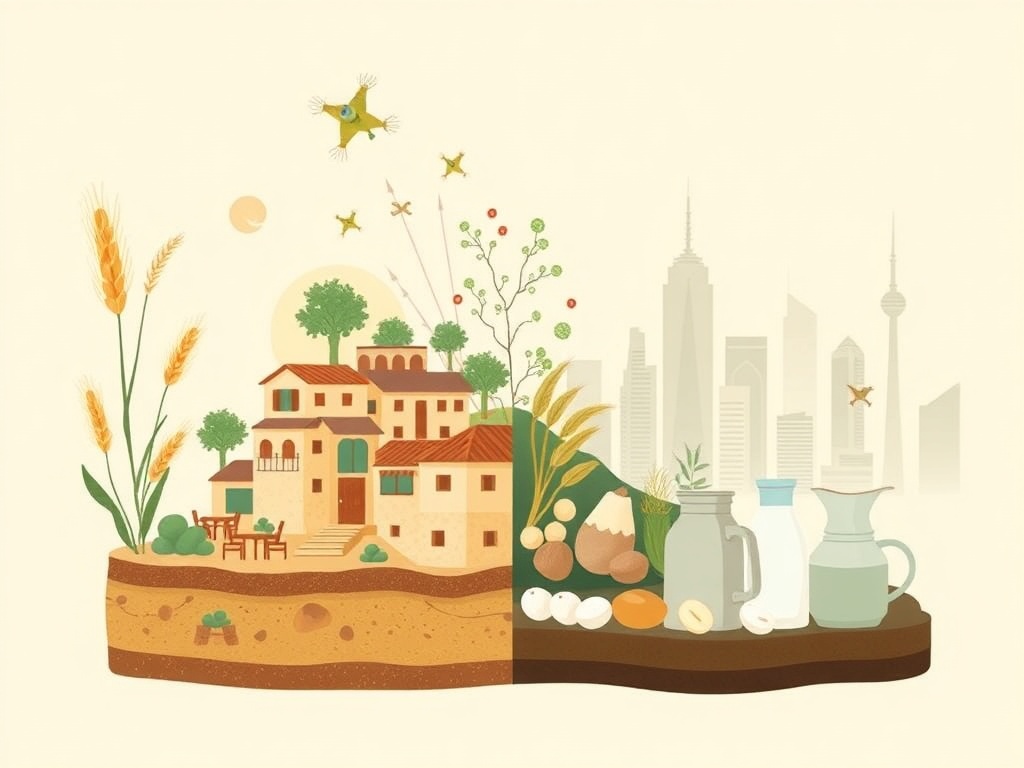
The assumption that urbanization reshapes the gut microbiome in predictable, universal ways turns out to be far too simplistic — at least across South Asia. For the roughly two billion people navigating the region's rapid lifestyle transitions, this finding reframes how researchers and clinicians should think about microbiome-linked disease risk, because community identity and local geography may matter more than whether someone lives in a village or a city.
The SAMBAR dataset — 575 adults drawn from ten geographically and culturally distinct South Asian communities, each sampled in both ancestral villages and urban centers — reveals that microbial composition correlates more strongly with community membership and geography than with rural-versus-urban lifestyle per se. Critically, microbiome responses to urbanization were community-specific, not universal. In select communities, urbanization was associated with expansion of microbial modules linked to wheat consumption and dairy fermentation, suggesting a possible non-genetic adaptive pathway for populations carrying lactase non-persistence alleles. Meanwhile, urbanization markers across the cohort correlated with enrichment of Megamonas — a taxon associated with elevated blood glucose and reduced microbial diversity — which appeared at higher abundance in SAMBAR participants compared to global reference cohorts.
This work challenges a dominant paradigm in microbiome epidemiology: that Westernization produces a convergent microbial signature regardless of origin population. The SAMBAR findings suggest that microbial responses are shaped by the specific cultural, dietary, and ecological starting conditions of each community — meaning blanket interventions targeting the "urbanization microbiome" may miss their mark entirely. The study's controlled village-versus-city design within single ancestral communities is methodologically stronger than most cross-sectional comparisons, though the 16S amplicon approach limits species-level resolution, and causality cannot be inferred. The Megamonas-glucose association, if replicated with metagenomic and clinical endpoints, could prove especially relevant to South Asia's escalating type-2 diabetes burden. This is a genuinely important population-scale contribution that should recalibrate how microbiome studies are designed and interpreted globally.