The concept of a "brain clock" — a biological readout that tells whether your brain is aging faster or slower than your calendar age — has mostly required expensive MRI scanners and structural imaging. A new approach grounded in electrical brain rhythms could democratize that assessment, with implications for early detection of cognitive decline across vastly different populations and socioeconomic contexts.
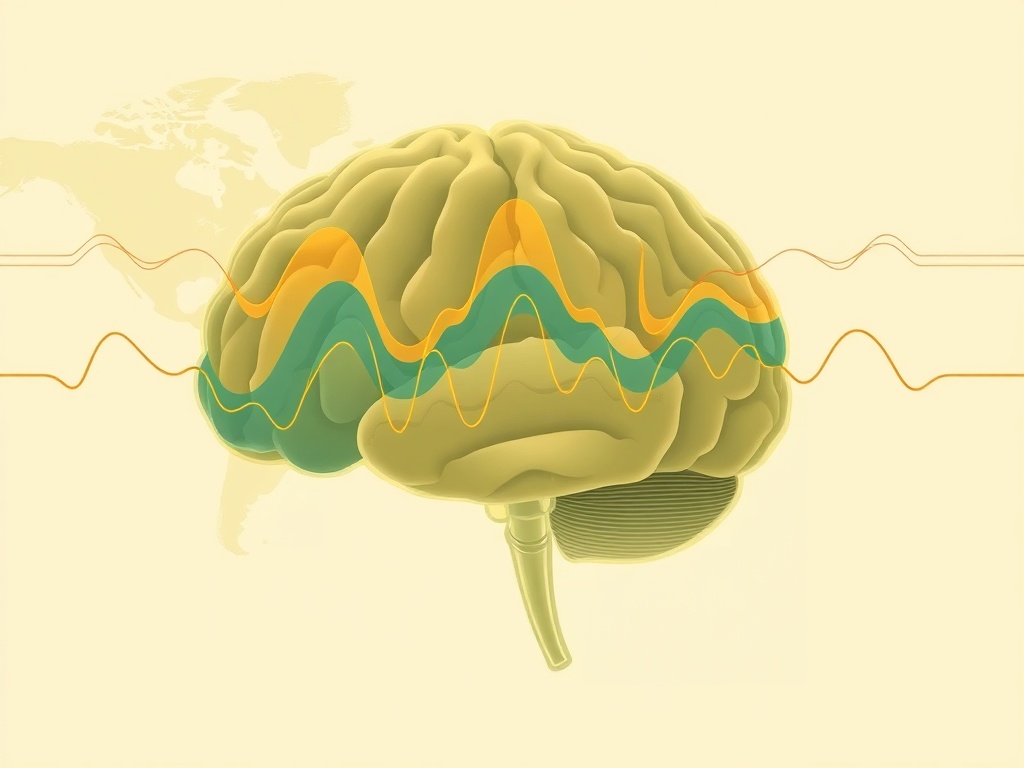
Drawing on resting-state electroencephalography (rsEEG) from 1,228 participants across 10 countries, researchers computed a brain age gap (BAG) — the difference between chronological age and model-predicted brain age — using spectral features of alpha oscillations (roughly 8–13 Hz), the dominant rhythm of the resting brain. Participants ranged from cognitively healthy adults to those with mild cognitive impairment (MCI), Alzheimer's disease, and behavioral variant frontotemporal dementia. BAG was significantly elevated in MCI and dementia groups, with the largest divergences appearing in posterior cortical regions, consistent with the known vulnerability of parieto-occipital networks in Alzheimer's pathology. Critically, structural inequality — measured at the country level — emerged as the single strongest predictor of BAG, outweighing education, sex, and cognitive performance.
This finding carries substantial weight in the longevity science community. Alpha oscillations have long been known to slow with age and accelerate in neurodegeneration, but their use as a brain clock in diverse, multinational cohorts is relatively novel. The study's strength lies in its geographic breadth and its explicit modeling of sociodemographic inequality — a variable most neuroimaging studies quietly ignore. That structural inequality outpredicts cognition itself in shaping brain age gaps suggests that social determinants of health are literally encoded in neural rhythms, not just behavior. Key limitations include the cross-sectional design, which prevents causal inference, and variability in EEG acquisition standards across 10 sites. Still, the scalability of EEG relative to MRI positions this as a potentially paradigm-shifting tool for population-level brain health surveillance in low-resource settings.