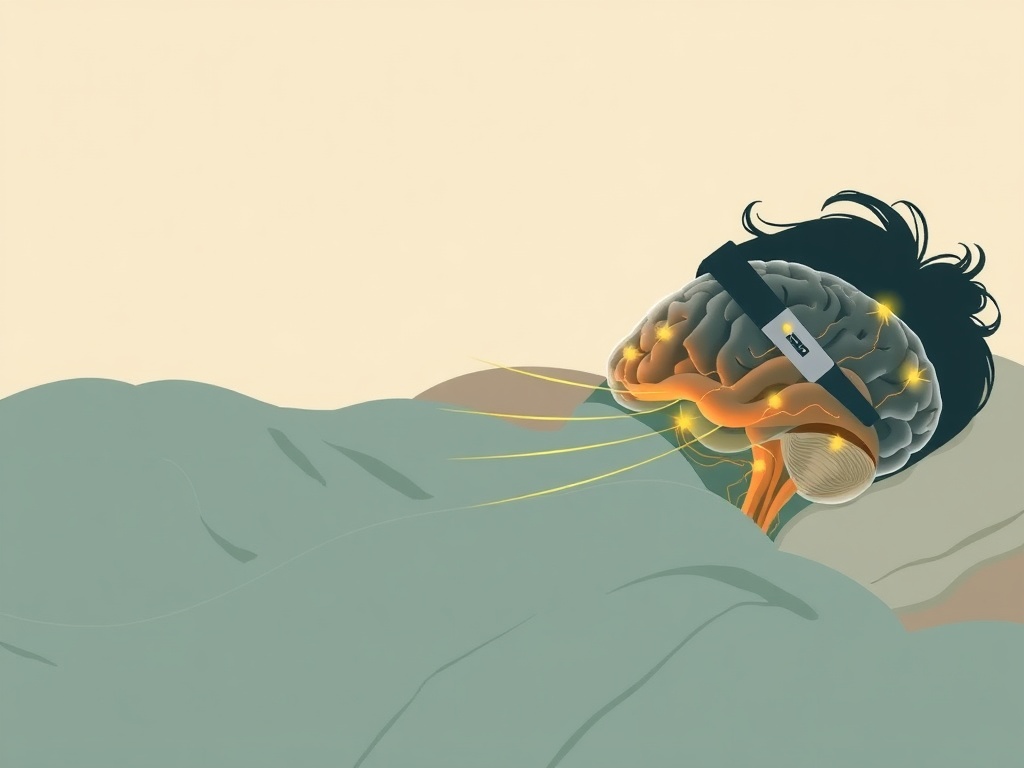
Understanding how the sleeping brain cleans itself has long been hampered by the inability to monitor the process in real time, outside a clinical setting. A new wearable device changes that equation — and the implications for tracking brain health, dementia risk, and sleep quality in everyday life could be substantial.
Published in Science Advances, the study introduces a soft, skin-conforming near-infrared spectroscopy (NIRS) system equipped with multi-wavelength LEDs and paired photodetectors that penetrate the scalp to detect subtle shifts in cerebral water content during sleep. Tested on multiple human subjects in their own homes over full overnight sessions, the device captured continuous, sleep-stage-dependent fluctuations in brain water dynamics. Spectral decomposition of the signal successfully resolved physiological rhythms including respiration, cardiac pulsatility, and slow-wave sleep oscillations — all of which are mechanistically tied to glymphatic-driven cerebrospinal fluid flow.
The glymphatic system — the brain's perivascular waste-clearance network — is most active during slow-wave (deep) sleep and has emerged as a central figure in the pathophysiology of Alzheimer's disease and other neurodegenerative conditions. Current gold-standard methods for studying it, such as contrast MRI or intrathecal tracer infusion, are invasive, expensive, and impossible to deploy longitudinally. This wearable NIRS approach is neither invasive nor confined to a laboratory, making it a meaningful technical leap. However, several caveats merit attention: NIRS does not directly measure cerebrospinal fluid flow — it infers glymphatic activity through a proxy signal (cerebral water content). The cohort appears small, and the specific number of subjects is not disclosed in the abstract, raising questions about statistical robustness. Additionally, motion artifacts during sleep remain a persistent challenge for forehead-mounted optical sensors. Nonetheless, this work is more than incremental — it opens a plausible path toward longitudinal home-based biomarkers of brain clearance efficiency, which could eventually inform sleep intervention strategies and early neurodegeneration screening.