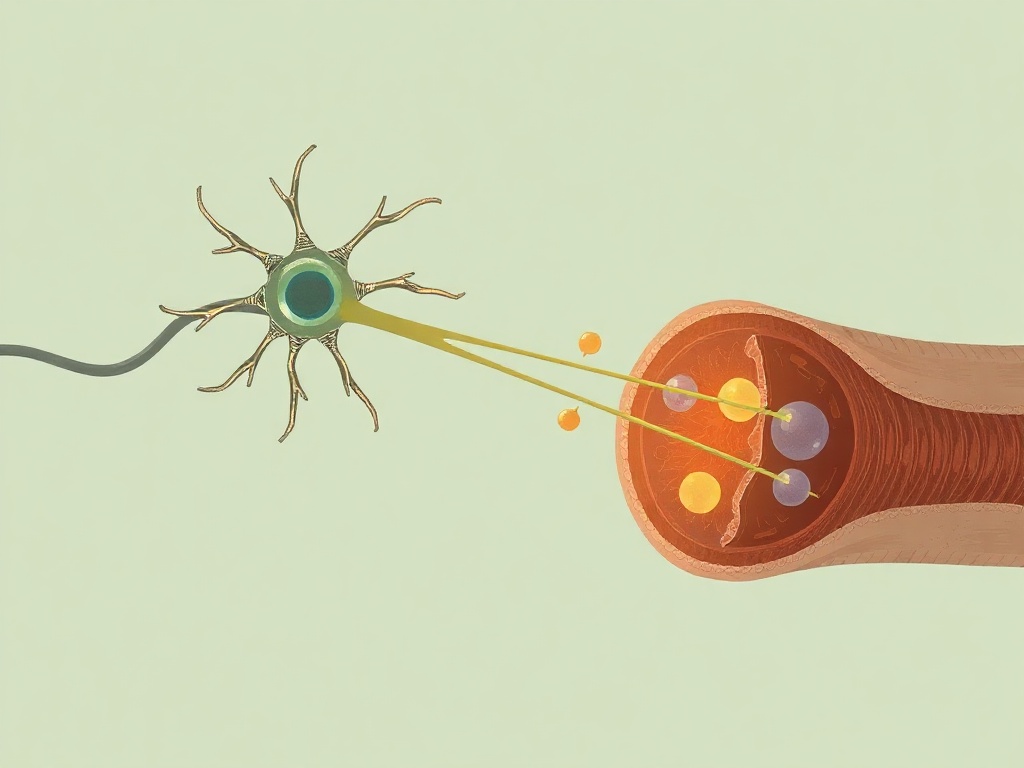
Understanding how the nervous system remotely governs cellular housekeeping in distant tissues could reshape how we think about age-related muscle wasting and neurogenic myopathies. A newly mapped mechanism in a well-established model organism reveals that the brain doesn't just move muscles — it also tells them when and how to clean up their own damaged components, with profound implications for conditions ranging from sarcopenia to ALS-adjacent muscle degeneration.
Working in Caenorhabditis elegans, investigators identified two independent neuronal circuits that together regulate the autophagy-lysosome pathway specifically within body wall muscle. The first circuit operates through electrical synapses — gap junctions formed by UNC-7 and UNC-9 proteins — connecting AVA interneurons to A-type motor neurons, which in turn suppress neuropeptide release to promote autophagy. The second circuit is chemically distinct: the TGF-β-like ligand DAF-7, secreted from ASI sensory neurons, activates autophagy through canonical TGF-β receptor signaling. Both pathways converge on a common effector — cytosolic calcium concentration in muscle cells. When either circuit is disrupted, calcium rises aberrantly, hyperactivating the protease calpain. This enzymatic overactivation results in dysfunctional autolysosomes that accumulate rather than degrade cargo, accelerating muscle degeneration.
This work is notable for several reasons beyond its elegant dual-circuit architecture. Calpain dysregulation has been independently implicated in human muscular dystrophies and age-related muscle loss, so the mechanistic link to autophagy quality control adds an important causal layer. The finding that sensory neurons — cells traditionally studied for environmental perception — participate in regulating intracellular recycling in peripheral tissues is a genuine conceptual expansion. That said, C. elegans lacks the anatomical complexity of vertebrate neuromuscular systems, and whether homologous circuits exist in mammals requires direct investigation. Still, given the deep evolutionary conservation of TGF-β signaling and gap junction proteins, this framework deserves urgent translational scrutiny. For the longevity field, dysfunctional autophagy is a recognized hallmark of aging; identifying upstream neural governors opens entirely new therapeutic entry points.