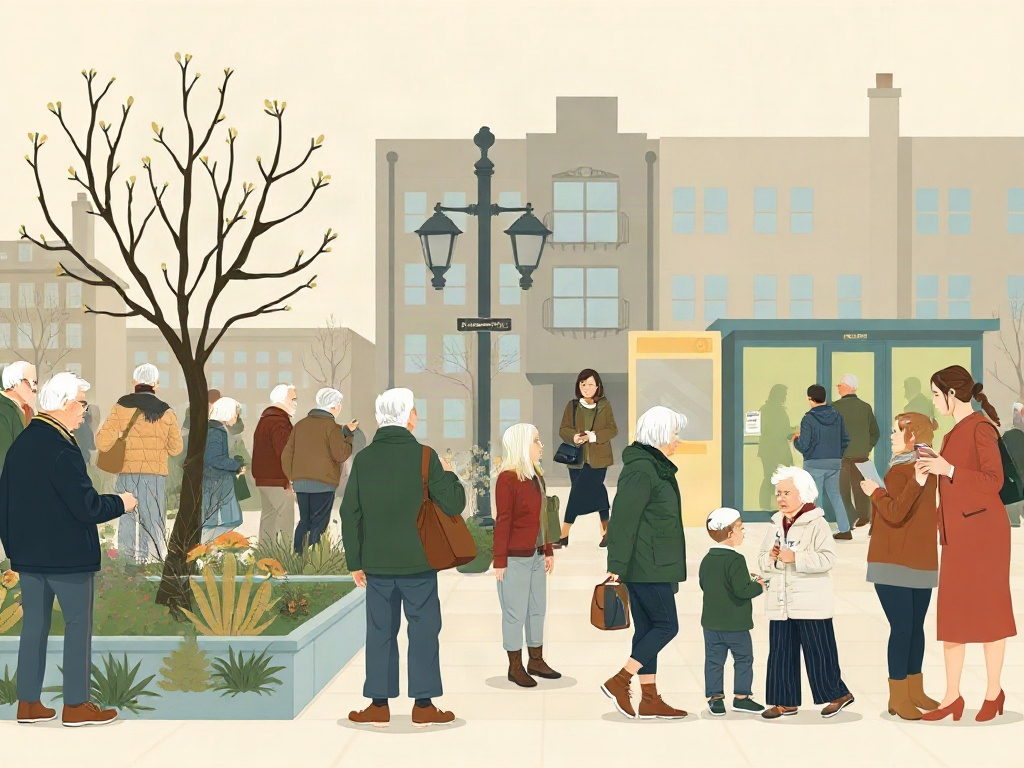
Loneliness is increasingly recognized as a chronic condition rather than a passing mood—one with measurable effects on healthspan. This multinational analysis quantifies, for the first time at scale, exactly how many years after age 60 people live in a state of loneliness, creating a metric—lonely life expectancy—that forces a reckoning with quality of later life alongside its duration.
Drawing on five harmonized longitudinal cohorts encompassing 61,511 adults aged 60 and older across 24 countries, researchers applied multistate Markov modeling to track transitions between lonely and non-lonely states over time. The headline figures are striking: total life expectancy at 60 averages 23.14 years, of which 4.31 years—roughly 19%—are spent in loneliness. Country-level wealth matters enormously: adults in high-GDP nations live 1.25 years longer overall and 2.40 fewer years in loneliness. Civil society participation—engagement in clubs, volunteer organizations, and civic groups—was associated with a 0.75-year gain in total life expectancy and a 2.78-year reduction in lonely years. Public transport accessibility correlated with a 1.97-year reduction in lonely life expectancy. At the individual level, female sex, low education, multimorbidity, and psychological disorders predicted transitions into loneliness, while physical activity was the principal factor associated with recovery from it. Counterintuitively, higher urbanization was linked to modestly longer total life expectancy but greater time spent lonely.
This study's strength lies in its cross-national scope and the novel LLE metric, which operationalizes loneliness as a population health burden comparable to disease burden estimates. The findings suggest that structural interventions—affordable transit, civic infrastructure—may be as potent as clinical ones. Key limitations include reliance on self-reported loneliness and the observational design, which precludes causal inference. The urbanization paradox also warrants deeper investigation. Still, the practical implication is significant: loneliness is not merely a subjective experience but a quantifiable drain on healthspan, responsive to societal-level levers that policymakers can actually pull.