Understanding whether excess weight in childhood causes lasting biological damage — or merely correlates with it — has profound implications for public health prioritization. A genetically informed longitudinal analysis now provides some of the strongest human evidence to date that elevated BMI during adolescence exerts a causal, not merely associative, effect on the pace of biological aging decades later.
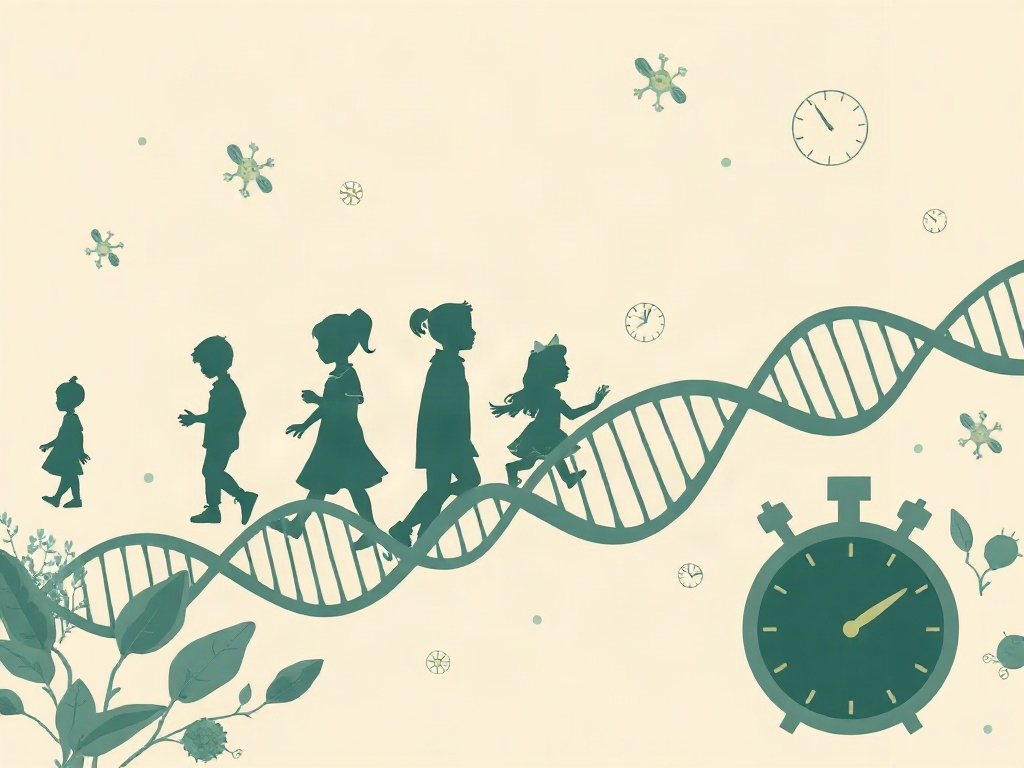
Drawing on the Young Finns Study, researchers tracked 3,596 participants from childhood through middle age, spanning roughly four decades. Biological aging was assessed using two epigenetic clocks — DunedinPACE, which measures the pace of aging in real time, and PC-GrimAge, a marker of accumulated biological age — at multiple follow-up points when participants were between 15 and 56 years old. BMI trajectories across ages 9 to 18 were modeled using latent growth curve analysis. Critically, polygenic risk scores derived from hundreds of genetic variants were used to quantify inherited liability to elevated BMI, and Mendelian randomization — a technique that exploits genetic variation to approximate randomized causal inference — was applied to individual-level data. Results indicated that adolescent BMI partially mediated the link between genetic predisposition and accelerated epigenetic aging, with Mendelian randomization analyses supporting a positive causal direction. Effects were more consistently captured by DunedinPACE than PC-GrimAge.
This study is notable for several reasons. Most prior work on BMI and biological aging is observational and cannot disentangle causation from confounding. The use of Mendelian randomization at the individual level, rather than summary-statistic two-sample MR, strengthens internal validity considerably. The finding that genetic liability to BMI acts partly through adolescent weight trajectories — rather than entirely through adult adiposity — implies a developmental window of particular biological sensitivity. However, epigenetic clocks remain imperfect aging proxies, and their translation into hard clinical endpoints (disease incidence, mortality) is still being validated. The study is also limited to a predominantly Finnish population, restricting generalizability. Overall, this qualifies as an incrementally paradigm-shaping finding: it shifts the conversation from correlation to causation and spotlights adolescence as a biologically consequential period for long-term aging trajectories.