The relationship between body composition and dementia risk is far more nuanced than the conventional 'obesity is bad' narrative suggests — and for older adults, the implications may be counterintuitive. A large meta-analysis synthesizing decades of cohort data reveals that the timing and type of body composition changes matter enormously for brain health trajectories, challenging blanket advice about weight management in aging populations.
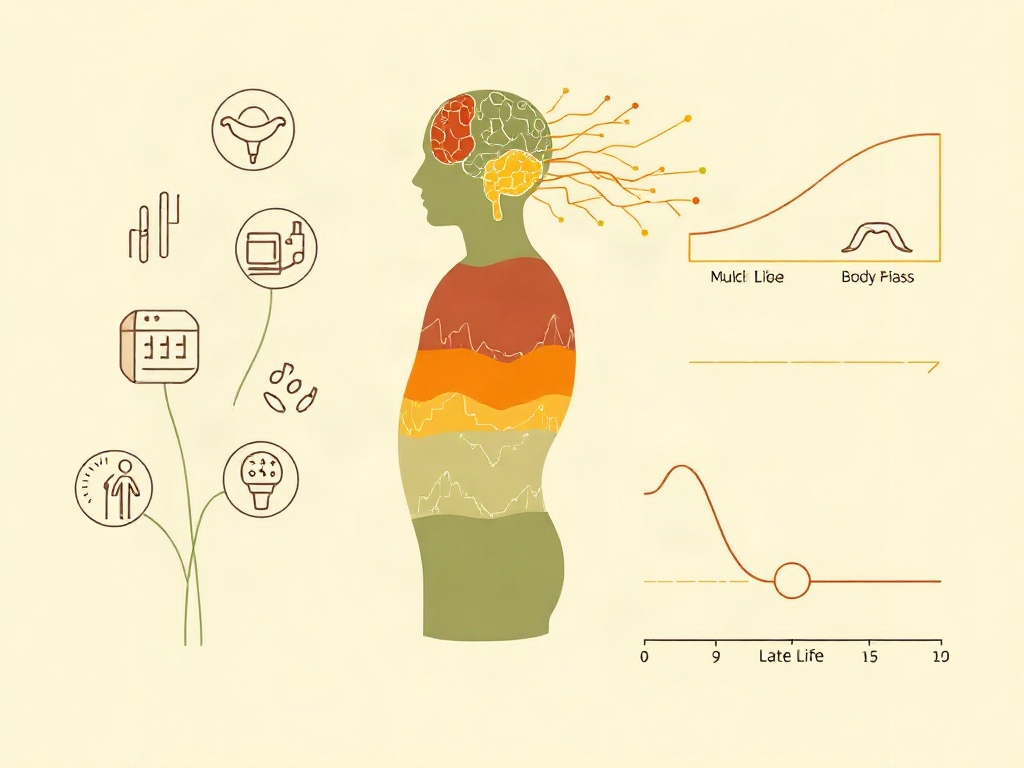
This systematic review pooled evidence from 14 publications on sarcopenia, 72 on obesity, and 4 on sarcopenic obesity, drawing from MEDLINE, EMBASE, Cochrane, and PsycINFO databases through February 2026. The age-stratified obesity findings are striking: mid-life obesity (under 65 years) modestly elevated all-cause dementia risk by 9% (HR 1.09, 95% CI 1.01–1.16), while late-life obesity (65 and older) was associated with a 17% reduced risk (HR 0.83, 95% CI 0.76–0.89). Sarcopenia — the progressive loss of skeletal muscle mass and function — carried the strongest signal, with a 42% elevated dementia hazard (HR 1.42, 95% CI 1.26–1.58). Notably, sarcopenic obesity, the co-occurrence of both conditions, showed no statistically significant association, though the confidence interval was wide.
The age-dependent obesity paradox aligns with what epidemiologists call the 'obesity paradox in aging,' where modest adiposity in later life may buffer neurological decline through inflammatory, metabolic, or nutritional reserve mechanisms. The sarcopenia finding is particularly important: muscle tissue is metabolically active, and declining muscle mass is linked to insulin resistance, neuroinflammation, and reduced neurotrophic signaling — plausible pathways to neurodegeneration. The null result for sarcopenic obesity is biologically puzzling and likely reflects the very limited evidence base (only four studies), making firm conclusions premature. From a practical standpoint, this meta-analysis reinforces that preserving skeletal muscle mass across the lifespan may be among the most modifiable targets for dementia prevention — more consistently than weight management alone. The findings are observational and cannot establish causation, and residual confounding from physical activity, diet, and socioeconomic factors remains a limitation.