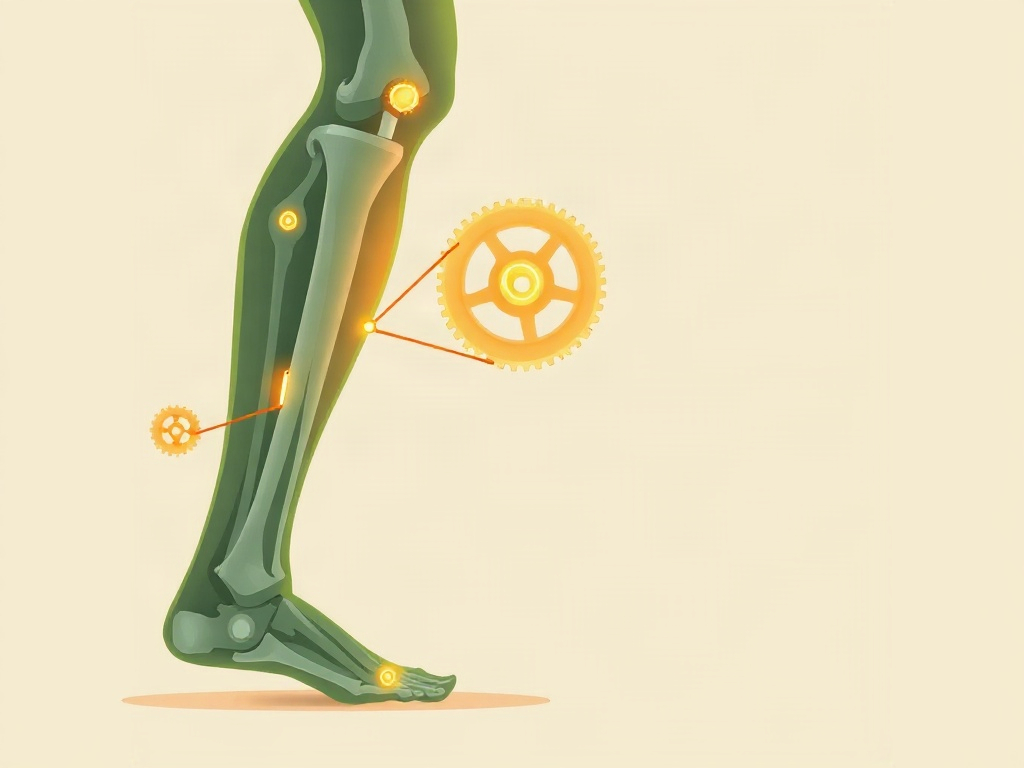
Most people think of extra muscles as biological backup systems — redundant by definition and metabolically costly to maintain. New research overturns that assumption by revealing that muscular redundancy serves a sophisticated mechanical purpose: it functions as a biological transmission system, dynamically redistributing power across joints the way a multi-speed gearbox optimizes engine output during cycling or driving.
Published in the Proceedings of the National Academy of Sciences, the study demonstrates that humans possess more muscles than the theoretical minimum required to move each joint, and this apparent excess enables a coordinated shifting of power production across the musculoskeletal system during normal walking. Rather than each muscle group operating in isolation, the redundant muscles collectively act as interchangeable power pathways — engaging differentially depending on walking speed, terrain, or mechanical demand — allowing the locomotor system to maintain efficiency across a wide range of conditions. The researchers mapped these inter-muscular power transfers using biomechanical modeling and found identifiable gear-like transitions rather than smooth, continuous redistributions.
This finding carries meaningful implications beyond basic science. In the broader biomechanics literature, muscle redundancy has long been treated as a computational nuisance — the so-called "muscle redundancy problem" in motor control — because infinite solutions exist for how the nervous system could distribute load across available muscles. This work reframes that redundancy as a feature, not a bug, with a specific mechanical logic. For clinical applications, it could inform prosthetic limb design and exoskeleton engineering, where current devices lack this adaptive power-shifting architecture. It may also explain why aging-related muscle loss disproportionately impairs walking economy even when gross strength is largely preserved — losing muscles may reduce available "gears" before it reduces raw force capacity. The study is computational and model-based, so validation through direct in-vivo muscle force measurement remains an important next step.