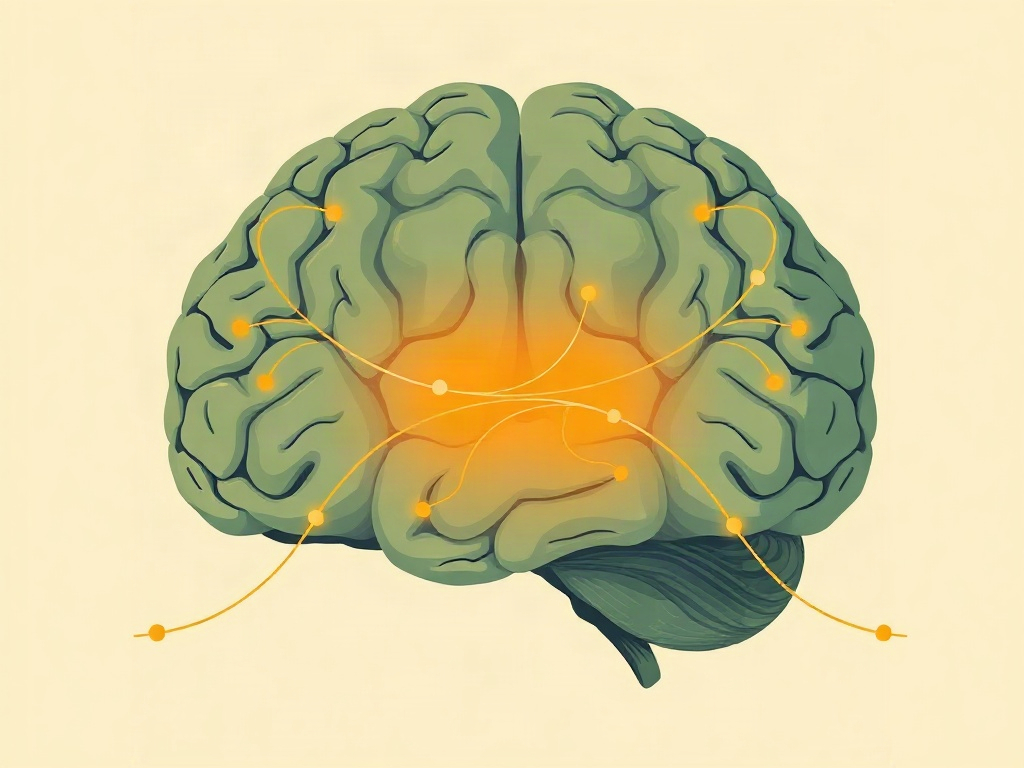
Fear and anxiety disorders affect roughly one in three adults over a lifetime, yet the neural architecture underlying fear expression remains poorly mapped. A newly identified left-right functional asymmetry in a conserved brain pathway opens a more precise anatomical target for therapeutic intervention — one that may explain why existing anxiolytics produce inconsistent results across individuals.
The medial habenula (MHb), a small but evolutionarily ancient brain nucleus, projects to the interpeduncular nucleus (IPN) via a pathway that researchers now demonstrate is not symmetrical. Functional GABA-B receptors differentially regulate synaptic transmission depending on whether the synapse originates from the left or right MHb. This hemispheric divergence in inhibitory tone was shown to produce asymmetric fear expression in mice, meaning the same circuit contributes to fear behavior in a lateralized, receptor-dependent manner. The finding implicates left-right differences in GABAergic signaling — rather than the circuit as a whole — as a key variable in fear modulation.
This result is notable for several reasons. First, the MHb-IPN axis has historically been understudied relative to the amygdala-prefrontal cortex fear circuit, yet it processes aversive states with evolutionary precedence across vertebrates. Second, neurological lateralization is well-documented in cortical systems but has rarely been mechanistically pinned to subcortical inhibitory receptors. If replicated in primates or humans, this asymmetry could explain individual variability in fear responses and stress susceptibility. Third, GABA-B receptors are already druggable — baclofen, a GABA-B agonist, is clinically approved — raising the question of whether lateralized dosing or hemisphere-targeted neuromodulation could improve precision psychiatry approaches for PTSD or phobia treatment. The study is in mice, so translational distance remains significant. Still, the mechanistic specificity here makes this more than incremental — it reframes a foundational assumption about bilateral symmetry in subcortical fear processing.