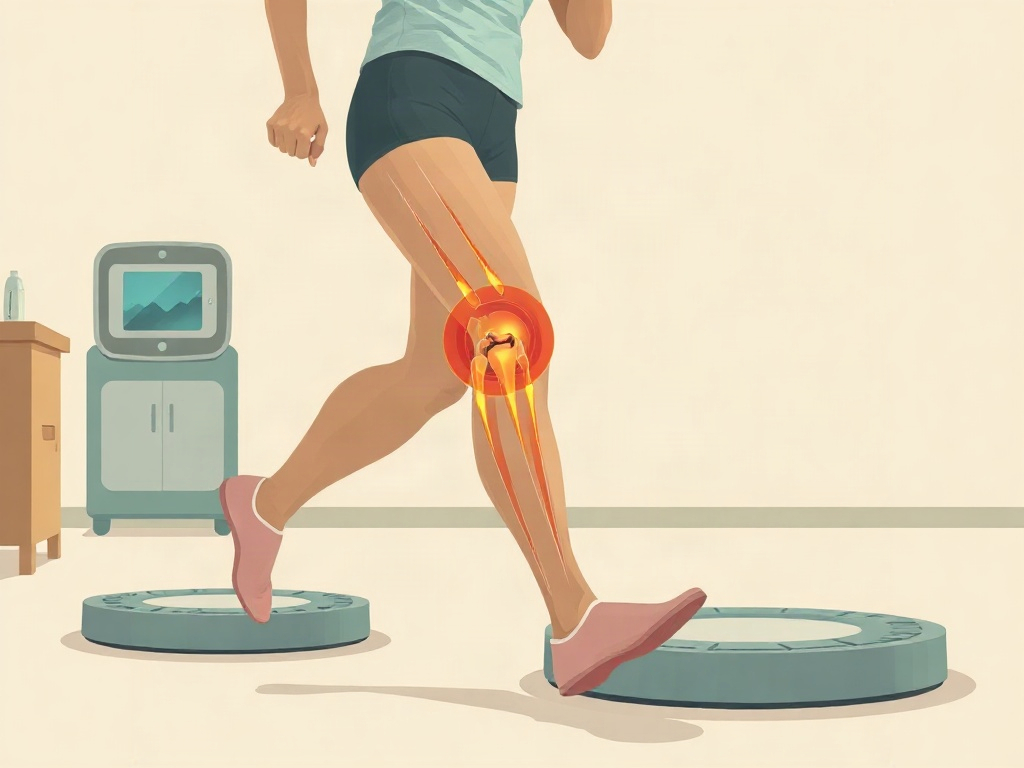
Rehabilitation protocols for running-related knee injuries have long been applied relatively uniformly across sexes, but mounting evidence suggests this one-size-fits-all approach may leave female runners undertreated in key biomechanical domains. A systematic review and meta-analysis now quantifies exactly where those sex-based movement differences concentrate — and the answer points squarely at the hip, not the knee itself.
Drawing on six major databases and culminating in 16 studies with 517 participants — approximately half female — researchers pooled biomechanical data from three-dimensional motion capture and force-plate assessments across three knee injury categories: patellofemoral pain (PFP), iliotibial band syndrome (ITBS), and ACL reconstruction. Meta-analyses across eight biomechanical variables revealed that females demonstrated meaningfully greater peak hip adduction (mean difference 3.84°, 95% CI 2.82–4.86) and peak hip internal rotation (mean difference 2.88°, 95% CI 1.35–4.41) during running compared to males with the same injuries. Critically, no statistically significant sex differences emerged at the knee or ankle — neither joint angles nor knee flexion and adduction moments differed by sex.
The finding that sex-based divergence in injured-runner biomechanics is localized to the hip rather than the knee carries meaningful implications for clinical practice and injury prevention research. Hip abductor and external rotator weakness has been established in prior work as a proximal contributor to patellofemoral load and iliotibial band tension, and these new data suggest female runners may arrive at injury with a biomechanical signature that warrants hip-centric assessment regardless of where the pain originates. That said, the 16-study pool is modest, PFP dominated the sample at 75% of participants, and causal direction remains indeterminate — these are cross-sectional snapshots, not longitudinal injury-mechanism studies. The analysis also cannot confirm whether observed hip angles represent a cause of injury, a compensatory response to it, or a stable anatomical trait. Nonetheless, this is a well-designed meta-analysis with clear clinical signal: sex-specific biomechanical screening during running may be warranted for injured athletes.