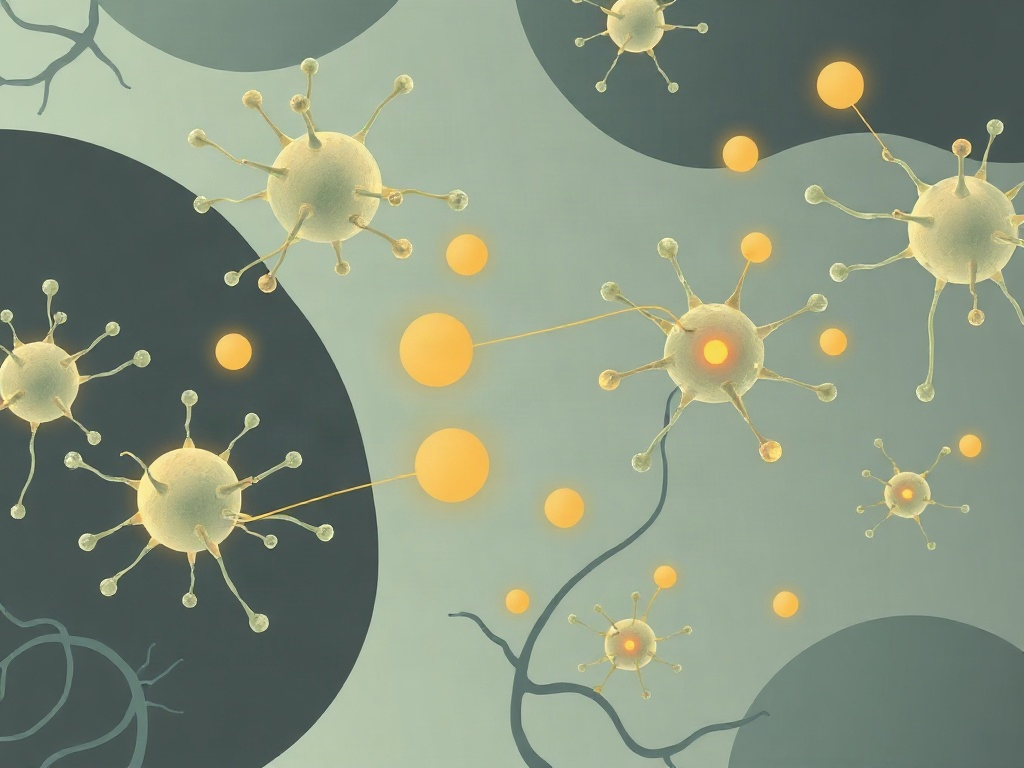
Cellular aging in the brain may not be an isolated event confined to individual neurons or glia — it appears to be contagious. The discovery that senescent brain cells actively signal neighboring healthy cells into a dysfunctional state fundamentally reframes how neurodegeneration and cognitive decline might be understood and eventually interrupted.
Published in Aging Cell, this study systematically mapped how the senescence-associated secretory phenotype (SASP) — the inflammatory cocktail released by senescent cells — propagates dysfunction across the major human brain cell types: neurons, astrocytes, microglia, and oligodendrocytes. The researchers profiled cell-type-specific SASP compositions and, crucially, charted the directional pathways through which senescence spreads between distinct cell populations. Using ligand-receptor interaction analysis, they identified specific molecular pairs responsible for paracrine senescence transmission. Targeted inhibition of select SASP factors measurably reduced the spread of senescent phenotypes in a cell-type-dependent fashion, and downstream immune cell responses were also modulated.
This work sits at the intersection of two rapidly converging fields — senescence biology and neurodegeneration — and its implications deserve careful consideration. The finding that senescence propagation follows cell-type-specific directional rules suggests that blanket senolytics (drugs that clear all senescent cells) may be a blunt instrument; precision targeting of specific SASP signaling axes within particular brain cell populations could be both more effective and safer. The inhibitor experiments are particularly noteworthy, offering early proof-of-concept for therapeutic intervention, though these remain in vitro or model-system findings requiring extensive validation in human tissue and eventually clinical settings. The study does not resolve whether SASP-mediated spreading is a primary driver of neurodegeneration or a secondary amplifier — a distinction that will matter enormously for therapeutic design. Still, the granular SASP ligand-receptor map produced here gives the field actionable molecular targets that were previously poorly defined in brain-specific contexts, making this a meaningfully advancing contribution rather than incremental refinement.