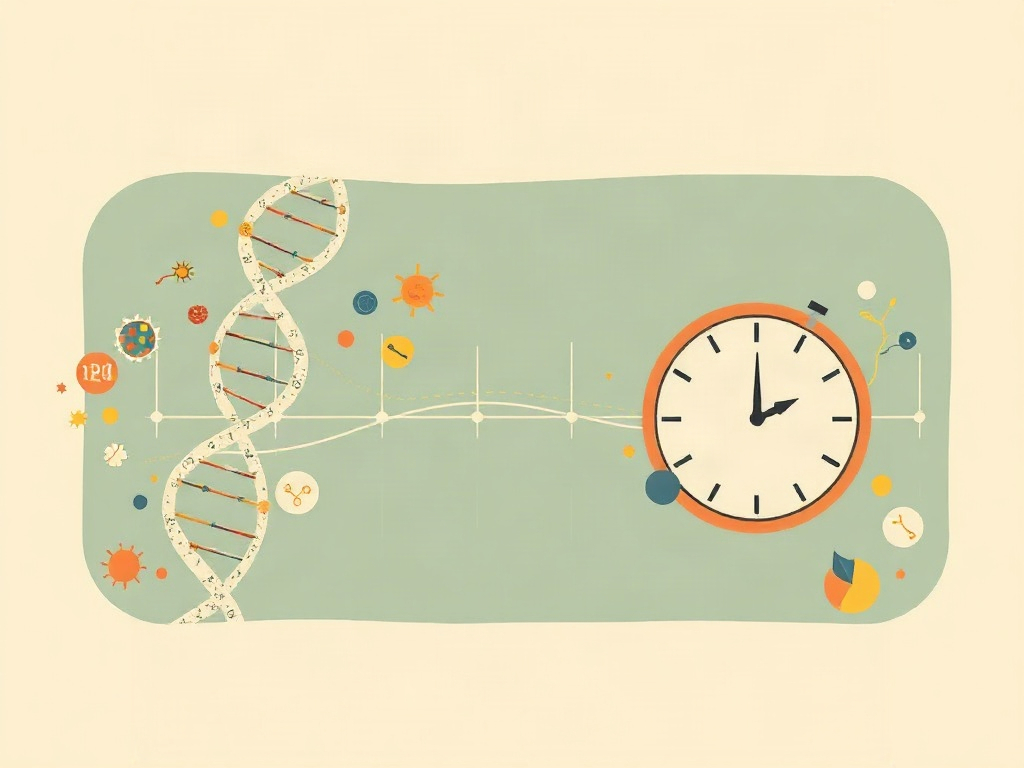
The assumption that aging unfolds similarly in men and women has quietly shaped decades of longevity research — and it may be fundamentally wrong. New large-scale clock models built separately for each sex are exposing not just quantitative differences in how fast men and women age, but qualitative differences in when and how biological aging accelerates, with distinct metabolic and tumor marker signatures driving each trajectory.
Published in Nature Aging, this research developed sex-stratified biological aging clocks by mining a large-scale human phenome dataset. Rather than applying a single universal clock, the authors constructed separate models for males and females that identified divergent aging transition points — discrete phases where biological age acceleration shifts measurably. Critically, the circulating signatures underlying these transitions differed between sexes: systemic metabolic markers and tumor-associated proteins emerged as sex-specific features of biological aging, suggesting that the molecular grammar of aging is not gender-neutral.
This work arrives at an important moment in the longevity field. Most existing epigenetic and biological clocks — including Horvath's original pan-tissue clock and even newer proteomics-based clocks like DunedinPACE — have been trained on mixed-sex populations, potentially obscuring sex-specific inflection points and mechanistic pathways. The identification of tumor marker signatures as aging features is particularly noteworthy: it raises questions about whether rising cancer biomarkers in midlife partly reflect accelerated biological aging rather than, or in addition to, early oncogenesis. Key limitations include the observational design, which cannot establish causality, and the degree to which phenome-scale data captures real-world biological heterogeneity. Whether these sex-specific clock features translate into actionable intervention targets remains to be tested in longitudinal or interventional designs. Still, this represents a meaningful methodological advance — a potentially paradigm-shifting reframing of how biological aging should be modeled and interpreted across the sexes.