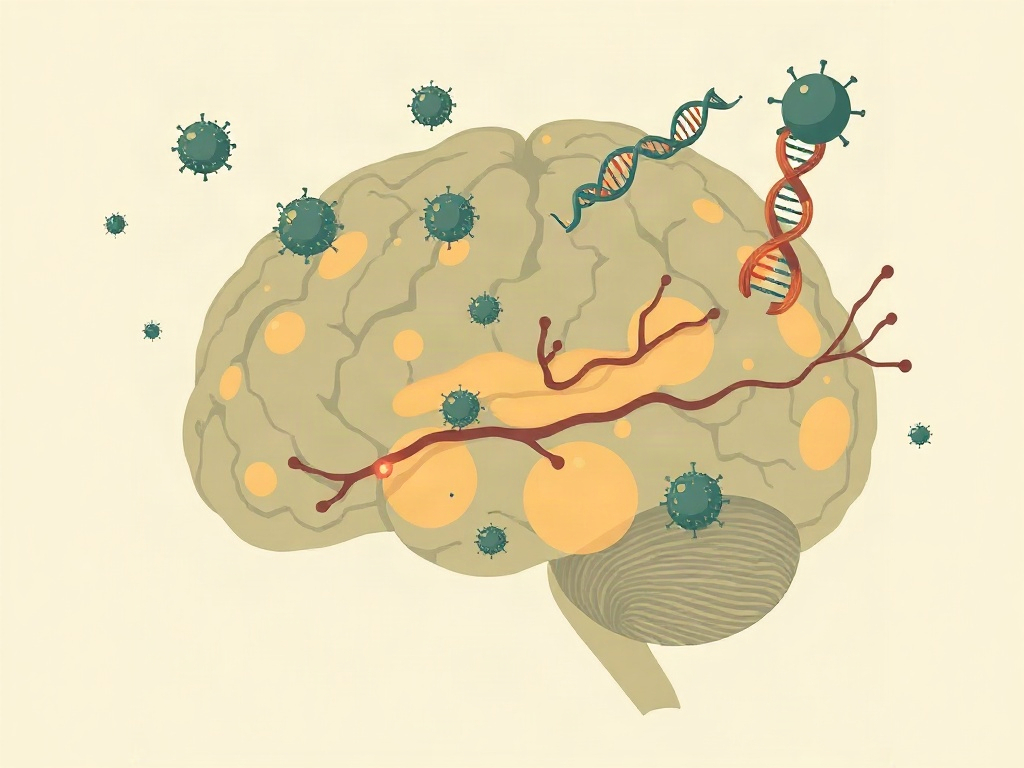
The boundary between cancer biology and neurodegeneration research is proving far more porous than previously assumed — and this matters enormously for how the field conceptualizes Alzheimer's disease (AD) risk and progression. Evidence that the same genetic mutations driving blood cancers may also corrupt the brain's resident immune cells challenges the long-held view that AD neuroinflammation is simply a reaction to amyloid or tau pathology. Instead, intrinsically altered immune cells may be active instigators.
Deep panel sequencing — at greater than 1,000× coverage across 311 brain samples — revealed a significant enrichment of somatic single-nucleotide variants (sSNVs) in known cancer driver genes within AD brains. Crucially, these mutations clustered in genes linked to clonal hematopoiesis (CH), including TET2, ASXL1, and DNMT3A. The same variants appeared in both brain microglia-like macrophages and paired blood samples from the same individuals, strongly implicating a shared hematopoietic origin — meaning these mutant cells likely migrated from bone marrow into brain tissue. Single-nucleus RNA sequencing of 62 additional brains confirmed elevated somatic copy number variants in AD microglia-like brain macrophages, while multi-omic single-cell analyses showed that mutation-carrying cells displayed inflammatory and proliferative transcriptional signatures consistent with disease-associated microglia states. iPSC-derived microglia engineered with TET2, ASXL1, and DNMT3A mutations recapitulated these signatures experimentally.
Clonal hematopoiesis has already been linked to cardiovascular disease and all-cause mortality, but this work positions it as a plausible upstream driver of AD neuroinflammation — a potentially paradigm-shifting reframe. The hematopoietic origin hypothesis is compelling because clonal mutations in blood stem cells are extraordinarily common in aging adults over 70, meaning a large population may carry latent neuroinflammatory risk. Key limitations include the study's observational design — causal directionality from CH mutations to AD cannot yet be confirmed — and uncertainty about what fraction of brain macrophages must carry these variants to meaningfully alter disease trajectory. If replicated, this line of evidence could make clonal hematopoiesis screening a novel early-warning biomarker for AD neuroinflammatory risk.