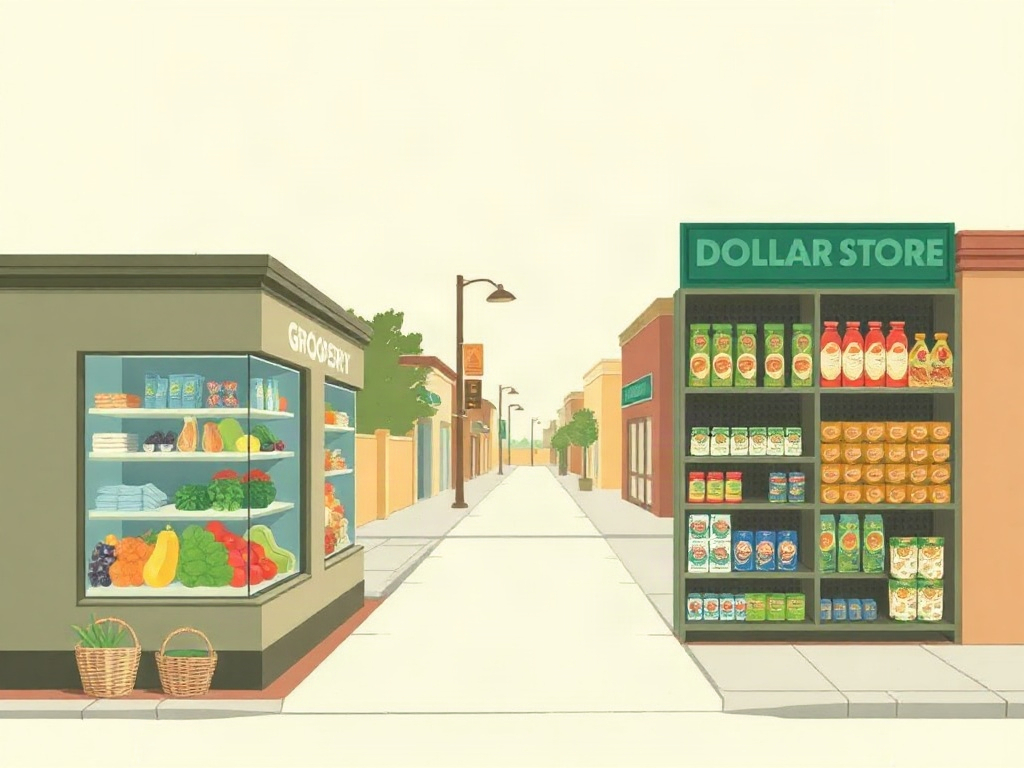
Food access research has long focused on whether a store exists nearby, but a growing body of evidence suggests that what's inside those stores may matter far more than their mere presence. As dollar stores have multiplied across American communities — particularly in lower-income and rural areas — they've often been counted in food-access metrics as equivalent to grocery stores. This study challenges that equivalence head-on, with significant implications for public health surveillance and urban planning.
Analyzing geocoded retail food locations across the contiguous United States, researchers assigned traditional grocery stores as "standard quality" and dollar stores as "low quality" based on their healthy food offerings — specifically differences in fresh produce, whole grains, and lean proteins. Using ArcGIS network analysis linked to CDC 500 Cities Project health data (2016–2017 estimates) covering metropolitan census tracts, and controlling for socioeconomic vulnerability via the CDC Social Vulnerability Index, the study found consistent negative health associations with proximity to dollar stores across most US regions. Conversely, proximity to standard-quality grocery stores was associated with better health outcomes. These patterns held across and within geographic regions, suggesting the food-quality distinction carries explanatory power independent of poverty or demographic composition.
This research adds meaningful weight to a hypothesis that has been difficult to test rigorously: that food environment quality, not just geographic access, drives diet-related health disparities. The food desert framework — which often treats any food retailer as access — has faced mounting criticism, and this study provides quantitative support for a more nuanced "food swamp" or food-quality model. Key limitations include the cross-sectional, observational design, which cannot establish causality, and the use of 2016–2020 data predating the dramatic post-pandemic dollar store expansion. Results are also restricted to metro areas, potentially underrepresenting rural dynamics. Still, the regional consistency of findings elevates this beyond a localized signal — it reads as a confirmatory contribution to a paradigm shift in how food access should be measured and regulated.