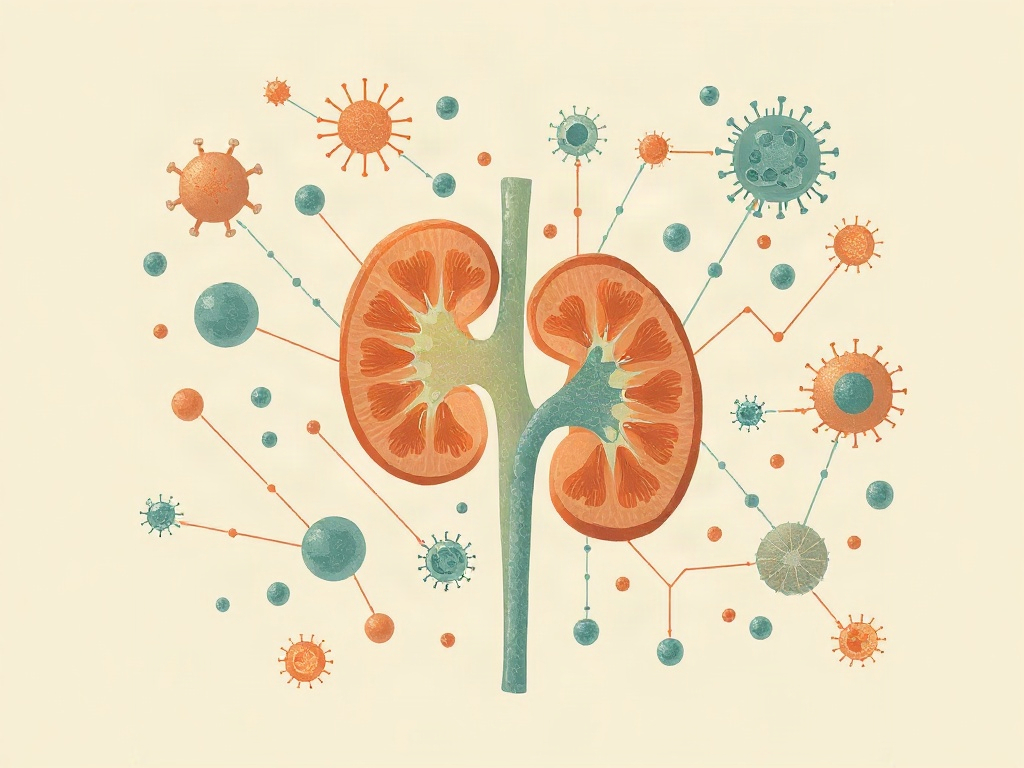
Chronic kidney disease affects roughly 10% of the global population, yet its deep mechanistic entanglement with biological aging has only recently been articulated with enough precision to suggest actionable interventions. A comprehensive review in Ageing Research Reviews reframes the failing kidney not as a passive casualty of aging but as an active amplifier of systemic inflammaging — a designation that shifts how clinicians and researchers should think about CKD management across the lifespan.
The review's central argument is that renal tubular epithelial cells, podocytes, and mesangial cells accumulate senescence burden and adopt a senescence-associated secretory phenotype (SASP), releasing pro-inflammatory cytokines, proteases, and extracellular vesicles that propagate inflammation both locally and systemically. Several converging mechanisms are identified as key drivers: NLRP3 inflammasome activation (which amplifies IL-1β and IL-18 signaling), mitochondrial dysfunction impairing cellular energy homeostasis, epigenetic clock acceleration, and bidirectional gut-kidney crosstalk mediated by microbial metabolites and uremic toxins. These processes are mapped across specific pathologies including diabetic nephropathy and the clinically underappreciated AKI-to-CKD transition. On the diagnostic side, the review evaluates single-cell transcriptomic signatures and extracellular vesicle biomarkers as emerging patient-stratification tools. Therapeutically, senolytics, SASP neutralization strategies, and SGLT2 inhibitors are highlighted as promising combinatorial approaches.
This synthesis is analytically valuable precisely because it integrates multiple research streams — senescence biology, immunometabolism, and microbiome science — into a unified renal aging framework. That said, the majority of mechanistic evidence cited remains preclinical or observational; few senolytic or SASP-targeting interventions have completed large-scale human trials in CKD populations specifically. SGLT2 inhibitors represent the most clinically validated anchor in this therapeutic landscape, with robust cardiovascular-renal outcome trial data, while senolytic strategies (navitoclax, dasatinib-quercetin combinations) remain largely Phase I/II. The framing of the kidney as an inflammaging amplifier — rather than merely a victim — is a potentially paradigm-shifting perspective that could accelerate biomarker-driven trial design and justify earlier, combination-based interventions in aging adults with declining renal function.