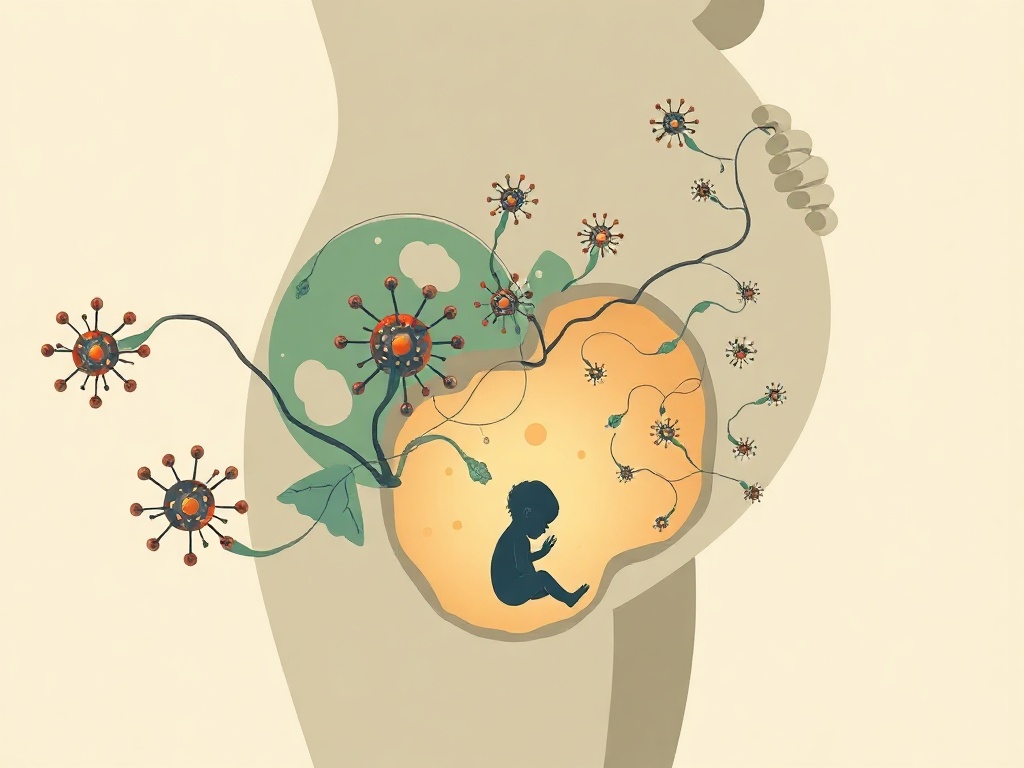
Understanding how the womb environment programs an infant's biological future is one of the most consequential questions in modern medicine. This large prospective study offers a systematic framework for connecting maternal environmental exposures — from metabolic status to chemical burden — through the microbiome, to measurable infant health outcomes at birth and beyond. The implications extend well past obstetrics: if prenatal exposome signatures reliably predict infant microbiome composition, early interventions during pregnancy could theoretically redirect long-term health trajectories before birth.
Published in PNAS from one of the largest prospective pregnancy cohorts with comprehensive exposome phenotyping, this research establishes a coherent prenatal exposure–microbiota–infant health axis. The investigators found that maternal anthropometric measures and clinical indicators ranked among the strongest determinants of both the composition of the infant microbiome and downstream neonatal health markers. The exposome approach — integrating dozens of internal and external environmental signals simultaneously rather than studying single exposures in isolation — revealed hierarchical patterns of influence that single-variable studies routinely miss.
This work sits at the intersection of two rapidly maturing fields: exposomics and the developmental origins of health and disease (DOHaD). What makes this study analytically notable is the simultaneous multi-domain phenotyping — covering lifestyle, metabolic, and environmental chemical variables — applied to a prospective design, which strengthens temporal inference compared to retrospective case-control studies. That said, the word 'establish' in the authors' framing deserves scrutiny: prospective cohort data can clarify association strength and directionality but cannot definitively confirm causality. The microbiome is notoriously plastic and shaped by many unmeasured variables. Replication in diverse ethnic and geographic cohorts will be essential, since maternal body composition and clinical norms vary substantially across populations. Nonetheless, the scale and integrated methodology make this a meaningful advance — confirmatory of DOHaD theory, yet substantively richer in mechanistic granularity than prior efforts.