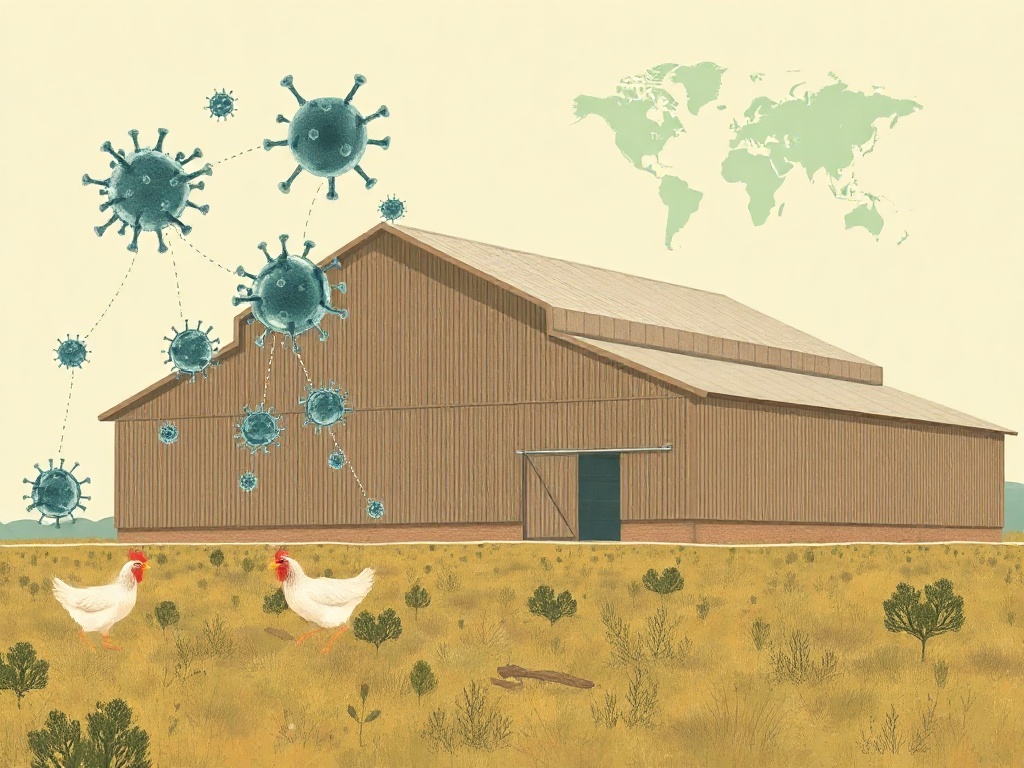
Food safety discussions often focus on contamination events, but a more consequential story may be unfolding at the evolutionary level — one where humanity's appetite for cheap poultry protein is actively reshaping the genetic trajectory of one of the world's most common bacterial pathogens. This reframing matters because it shifts Campylobacter from a manageable food-hygiene problem to a long-term infectious disease risk driven by agricultural infrastructure itself.
Published in PNAS, this study examines how the global intensification of industrial poultry farming has constructed what researchers characterize as a distinct ecological system that fundamentally reorganizes Campylobacter emergence, evolution, and cross-species transmission dynamics. The dense, genetically uniform flocks characteristic of intensive production create conditions that accelerate bacterial adaptation, strain diversification, and spillover into human populations. The authors situate this within the broader Anthropocene framework, arguing that human-driven environmental transformations — land use, agricultural scaling, biodiversity loss — function as systemic drivers of zoonotic risk rather than passive backdrop.
This finding arrives in a context where Campylobacter jejuni already causes an estimated 96 million human illnesses annually worldwide, surpassing Salmonella in many high-income countries. The evolutionary acceleration hypothesis advanced here aligns with emerging work on how agricultural intensification compresses host-pathogen co-evolutionary timescales, potentially generating antibiotic-resistant lineages faster than surveillance systems can track them. However, important limitations warrant caution: the excerpt does not clarify whether genomic, epidemiological, or modeling data underpin the central claims, and PNAS significance statements sometimes outpace the specific evidence presented within. The scope — global expansion framed through Anthropocene theory — is ambitious, and whether the causal mechanisms are demonstrated or inferred will determine how much weight this work should carry in policy and public health circles. Nonetheless, the conceptual contribution of treating industrial poultry systems as evolutionary engines for zoonotic pathogens represents a meaningful analytical advance beyond conventional farm-to-fork risk framing.