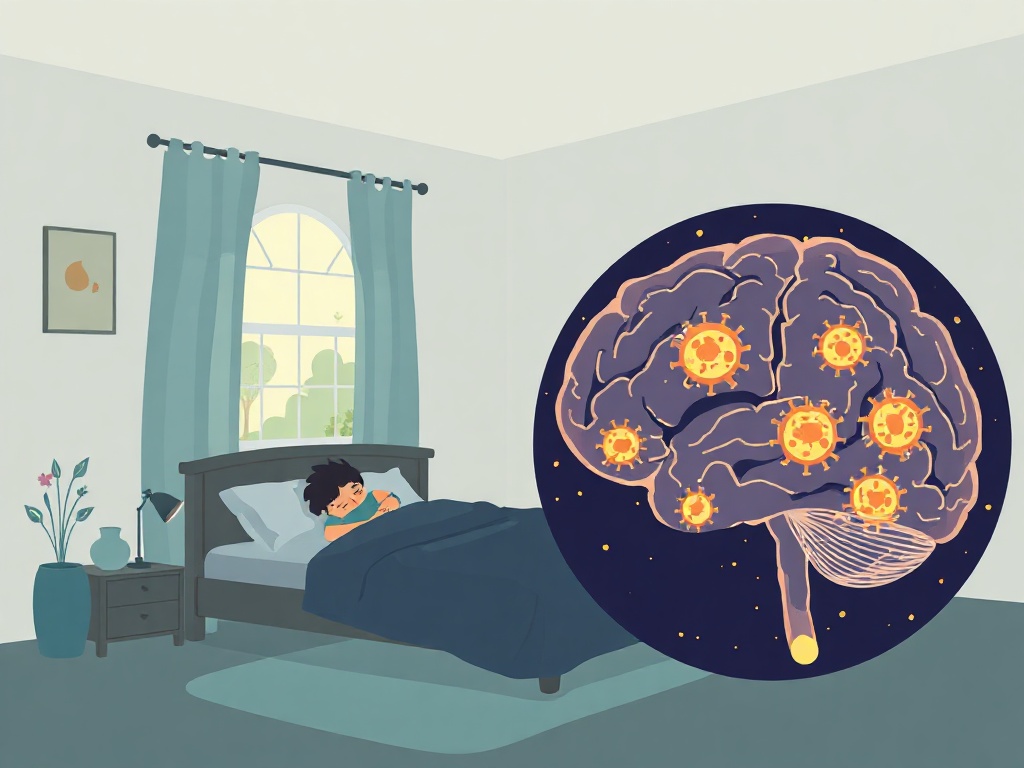
Light pollution may be one of the most pervasive and overlooked environmental risk factors for neurodegenerative disease. Millions of people sleep in rooms with ambient light from streetlights, screens, or electronics — levels far below what we consider bright — and this study raises the possibility that even low-grade nighttime light exposure meaningfully disrupts the biological machinery implicated in Alzheimer's disease progression.
Using a humanized amyloid precursor protein knock-in mouse model (hAPPSAA KI) that develops amyloid-beta plaques, researchers exposed 12–13 month-old animals to chronic dim light at night — 8 lux during the dark phase for 8 weeks, roughly the brightness of a dimly lit hallway. Within two weeks, circadian rhythm amplitude dropped and fragmentation increased across both genotype groups. In the Alzheimer's-relevant mice specifically, hippocampal plaque burden increased modestly, alongside elevated soluble neocortical amyloid-beta. More notably, microglial immune markers CD45 and MHCII rose significantly, with MHCII-positive cell counts elevated across both hippocampus and cortex, suggesting that ambient nighttime light primes microglia toward an antigen-presenting phenotype — a state associated with chronic neuroinflammatory signaling rather than efficient amyloid clearance.
This work fits into an increasingly coherent mechanistic picture linking circadian disruption to Alzheimer's risk. Prior research has established that slow-wave sleep drives glymphatic clearance of amyloid-beta, and that circadian misalignment accelerates tau phosphorylation. What this study adds is a causal environmental input — light, not just sleep loss — that independently fragments circadian architecture and shifts microglial behavior before cytokine cascades fully materialize. The 8 lux exposure level is particularly relevant because it falls within the range of typical bedroom light pollution. Key limitations include the animal model's inability to fully replicate human AD pathophysiology, the absence of downstream cytokine elevation at the 8-week mark (leaving open whether inflammation amplifies with longer exposure), and the lack of female cohort data. Still, for a field that has struggled to identify modifiable environmental risk factors, this is a meaningfully targeted and practically relevant finding.