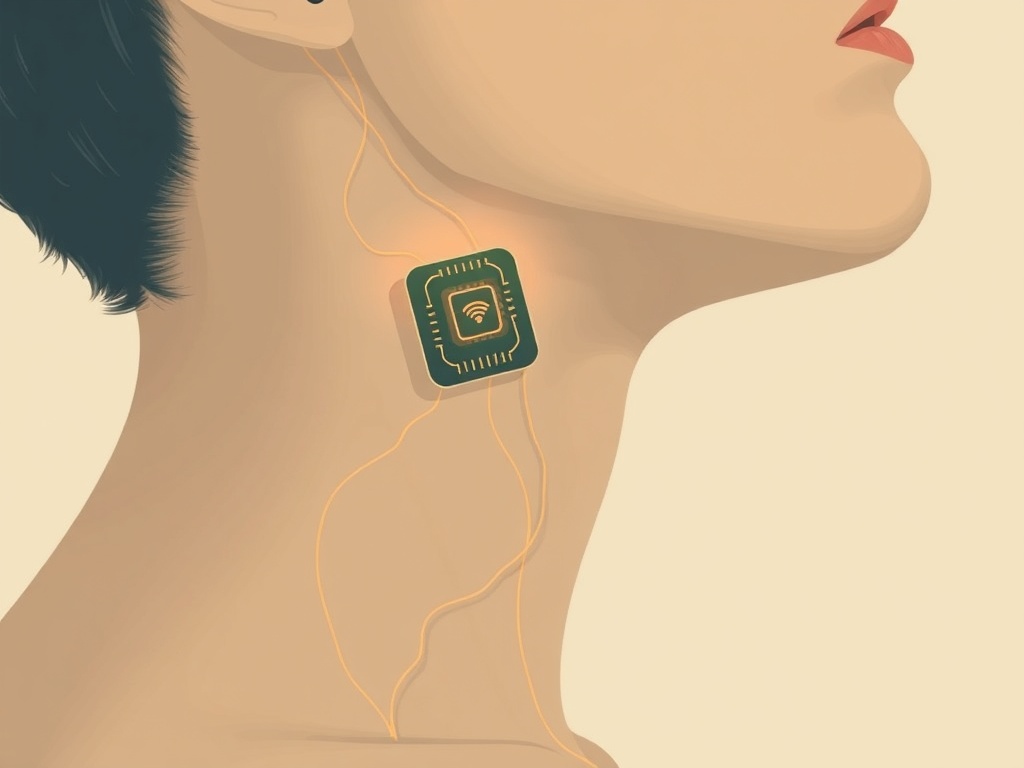
Depression affects roughly 280 million people globally, and a substantial minority — perhaps a third — do not respond adequately to antidepressant medications. Vagus nerve stimulation has shown genuine clinical promise for treatment-resistant depression, yet its adoption has been severely limited by the requirement for surgical implantation or, in transcutaneous versions, uncomfortably high surface currents. A device that could close that gap — effective neuromodulation through a simple, wearable patch — would meaningfully expand access to a proven therapeutic target.
Published in PNAS, this work describes a wireless, skin-adhering patch built around three-dimensional liquid metal electrodes. Unlike flat printed electrodes, the 3D architecture allows the conductive elements to conform intimately to skin topology, reducing impedance at the skin–electrode interface and enabling effective vagal activation at substantially lower current densities than conventional transcutaneous systems. The device transmits power and data wirelessly, eliminating the need for implanted pulse generators or tethered cables. Preclinical testing demonstrated measurable modulation of vagally mediated physiological signals, supporting the hypothesis that the electrode geometry meaningfully improves energy coupling to the underlying nerve.
The broader significance here sits at the intersection of materials science and psychiatric neuromodulation. Liquid metal composites — typically gallium-based alloys — have attracted considerable attention for their unique combination of electrical conductivity and mechanical compliance, but translating that promise into a clinically relevant, reproducible neural interface is a non-trivial engineering problem. This study offers one credible solution. That said, important limitations temper enthusiasm: the work appears to be preclinical or early-stage, and the leap from demonstrating vagal signal modulation in a controlled laboratory setting to demonstrating antidepressant efficacy in human trials is substantial. Transcutaneous VNS devices have previously shown mixed results in randomized controlled trials for depression specifically. The liquid metal approach is genuinely novel from an engineering standpoint, but clinical validation — including optimal stimulation parameters, long-term skin biocompatibility, and patient adherence — remains ahead. This is best classified as an incremental-to-promising advance warranting careful clinical follow-up.