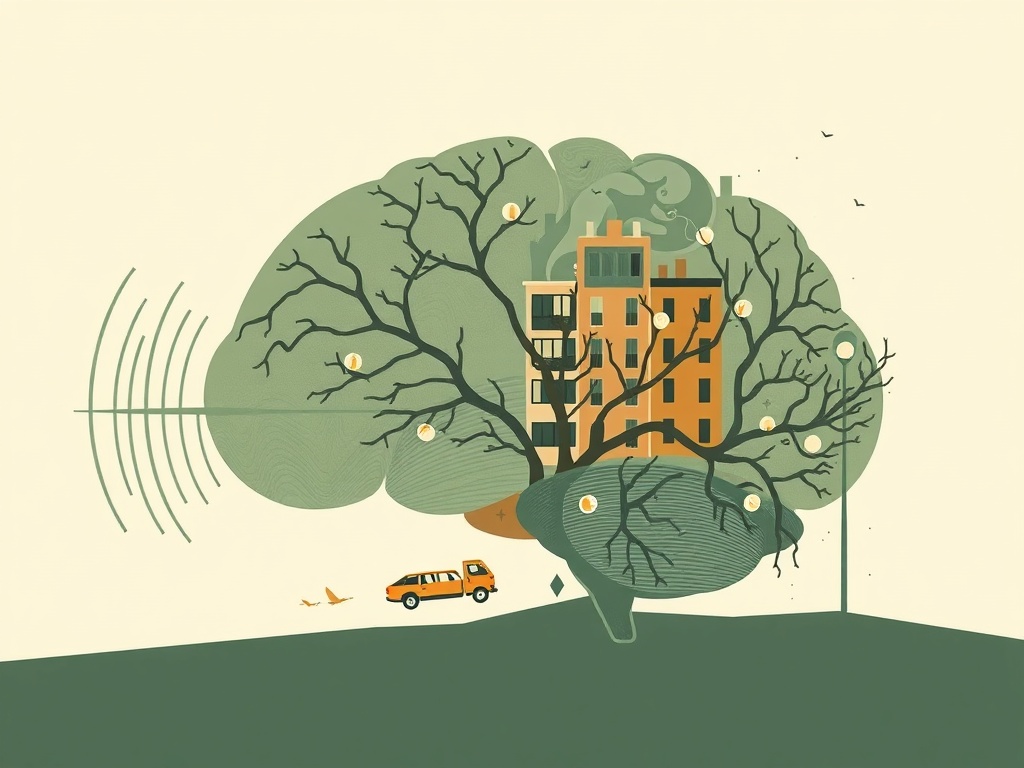
Environmental noise pollution has long been studied for its cardiovascular and metabolic consequences, but its potential role in neurodegeneration has received far less scrutiny. A large-scale Danish cohort study now adds epidemiological weight to the hypothesis that chronic acoustic stress from road traffic may contribute to Parkinson disease risk — a finding that could reshape how urban planners and neurologists think about modifiable environmental exposures.
Drawing on residential address histories spanning from 1990 and tracking over 3.1 million Danes aged 40 and older through 2017, investigators modeled decade-long time-weighted road traffic noise exposure at both the most and least exposed sides of participants' homes. Among the cohort, 20,587 individuals developed Parkinson disease during follow-up. Each interquartile increment of 11.5 decibels in maximum facade noise (LDEN-Max) was associated with a hazard ratio of 1.03 (95% CI, 1.00–1.05), after adjustment for sociodemographics and fine particulate matter air pollution — a statistically modest but population-meaningful association given the scale of urban noise exposure globally.
This finding sits at an important intersection of environmental neuroscience and epidemiology. The biological plausibility is credible: chronic noise exposure activates the hypothalamic-pituitary-adrenal axis, elevates systemic inflammation, and disrupts sleep architecture — all pathways implicated in alpha-synuclein aggregation and dopaminergic neuronal stress, the hallmark mechanisms of Parkinson pathology. The Danish register-based design is a methodological strength, enabling near-complete case ascertainment at a population scale rarely achievable elsewhere. However, a hazard ratio this close to unity demands caution; residual confounding from unmeasured exposures co-localizing with busy roads — pesticides, heavy metals, other pollutants — cannot be fully excluded. This is observational evidence, not causal proof, and the effect size is incremental rather than paradigm-shifting. Still, as a modifiable environmental variable affecting hundreds of millions of urban residents, even a marginal per-person risk translates to a substantial attributable burden at scale.