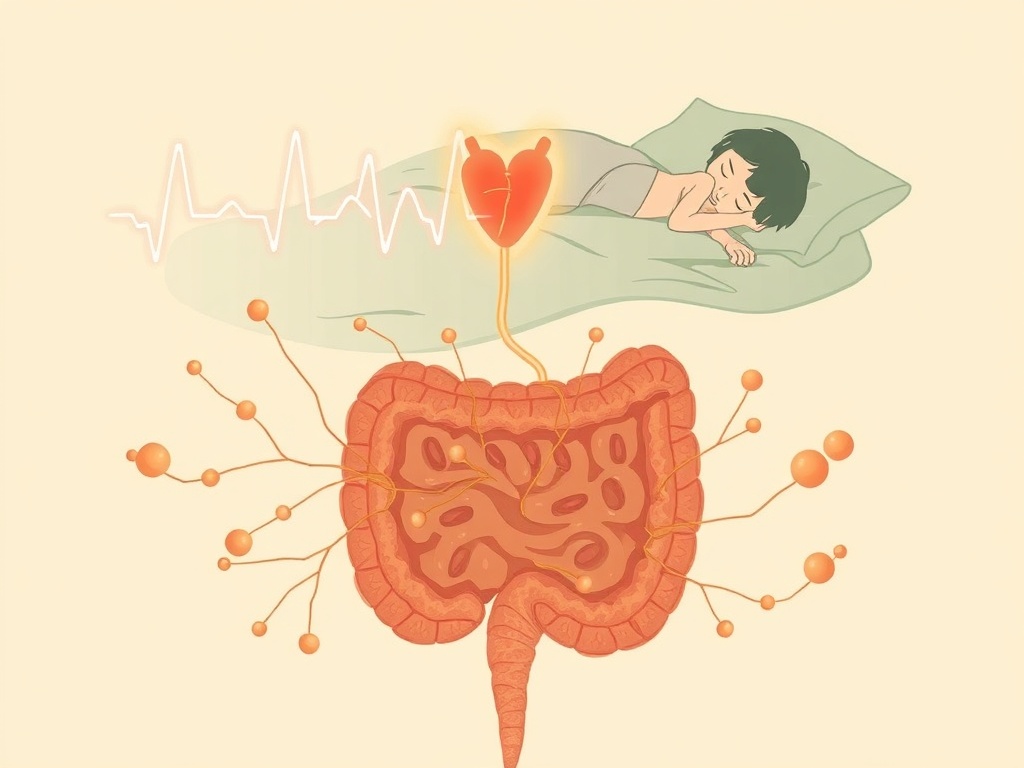
For the millions struggling with chronic insomnia, the dominant treatment paradigm has focused on the brain — cognitive behavioral therapy, sedatives, melatonin. A rigorous placebo-controlled trial now implicates the gut microbiome as an upstream regulator of sleep, operating through the autonomic nervous system rather than direct neurochemical sedation. This reframes insomnia as a condition with a measurable gut-brain axis component, not merely a disorder of psychological arousal or circadian timing.
This exploratory analysis was nested within an 80-person multicenter, double-blind, randomized placebo-controlled trial of fecal microbiota transplantation (FMT) for chronic insomnia disorder. The parent trial — which met its primary endpoint of improved polysomnography-measured sleep efficiency at one month — was extended here to examine heart rate variability (HRV) as a mechanistic readout. FMT significantly reduced the LF/HF ratio, a widely used index of sympathovagal balance, by -0.10 (95% CI: -0.18 to -0.02; p = 0.010). This shift indicates relative parasympathetic predominance following microbial reconstitution. Gut microbiota composition was characterized via 16S rRNA gene sequencing, and mediation analysis was used to evaluate whether autonomic changes statistically mediated the sleep improvements observed in the parent trial.
The findings are clinically provocative but require careful interpretation. The autonomic signal is modest in absolute magnitude, and the mediation analysis is statistical rather than causal — it cannot confirm that microbiome changes caused autonomic shifts that then caused sleep improvement. LF/HF ratio remains debated as a pure sympathovagal index in sleep medicine, and the one-month follow-up window leaves longer-term durability unanswered. That said, this is among the first RCT-embedded evidence linking microbial intervention to objective autonomic rebalancing in a sleep disorder, placing it meaningfully above observational or animal-model work. For researchers in psychosomatic medicine, the gut-autonomic-sleep pathway now has a controlled human trial lending it credibility — though replication in larger cohorts with extended follow-up is necessary before clinical translation.