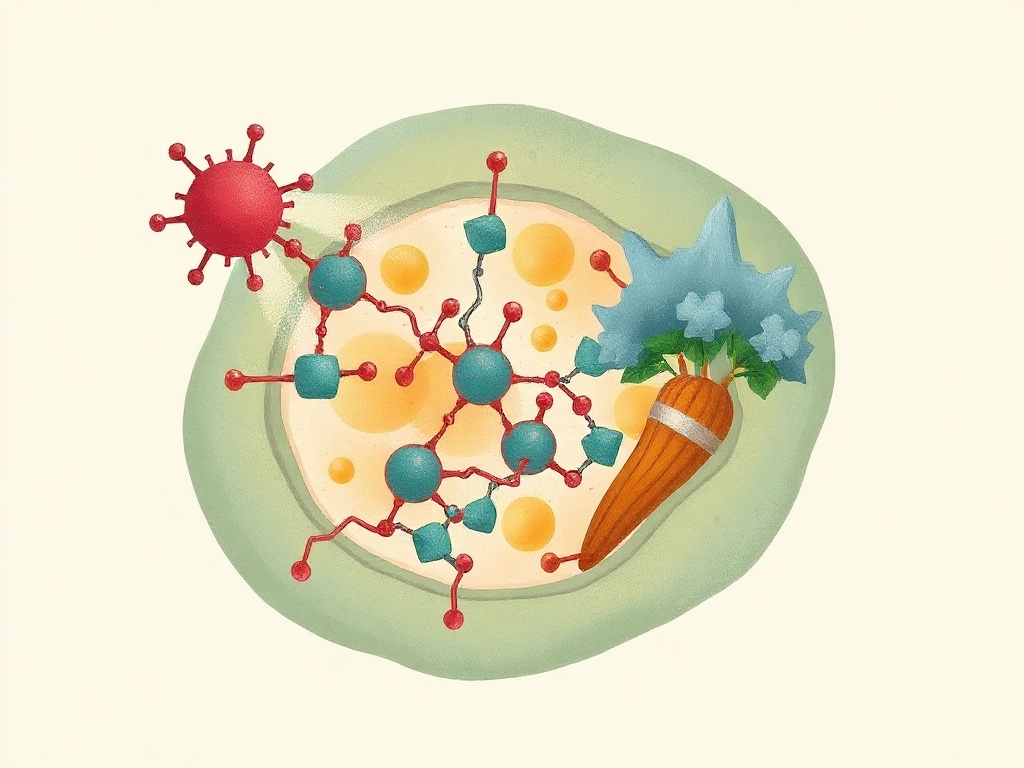
Cellular senescence has long been recognized as a double-edged phenomenon: senescent cells halt their own division but persist in tissues, secreting a toxic brew of inflammatory signals — the senescence-associated secretory phenotype (SASP) — that degrades surrounding tissue and accelerates systemic aging. A critical question has been whether the same molecular machinery that locks cells out of division also governs their inflammatory output, and whether a single pharmacological target could address both.
Wang et al., publishing in Nature Aging, reveal that CDK4 and CDK6 — kinases classically viewed as cell-cycle gatekeepers — perform a second, underappreciated role: they modulate the inflammatory phenotype of senescent cells through a pathway involving retinoic acid receptor alpha (RARα) and the master inflammatory transcription factor NF-κB. When CDK4/6 activity is pharmacologically disrupted, this CDK4/6–RARα–NF-κB signaling axis is interrupted, substantially reducing SASP output. Critically, this suppression of senescence-associated inflammation translated into measurable improvements in physical function across both natural aging models and models of chemotherapy-induced toxicity — contexts where senescent cell accumulation is particularly pronounced.
This finding carries meaningful implications beyond cancer survivorship. CDK4/6 inhibitors (palbociclib, ribociclib, abemaciclib) are already FDA-approved for certain breast cancers, meaning their safety and pharmacokinetics in humans are well-characterized — a considerable translational advantage over early-stage senolytics. However, several caveats deserve emphasis. The current evidence appears to derive from preclinical animal and cell models; human clinical validation is absent. CDK4/6 inhibition carries its own adverse effect profile, including myelosuppression, which complicates chronic use in aging populations. Furthermore, suppressing SASP rather than eliminating senescent cells is a senomorphic rather than senolytic strategy, and whether dampening inflammatory signaling long-term produces durable functional benefit — or inadvertently impairs tumor surveillance — remains unresolved. Still, mechanistically linking CDK4/6 to NF-κB via RARα is a genuinely novel contribution that reframes these drugs as potential geroscience tools.