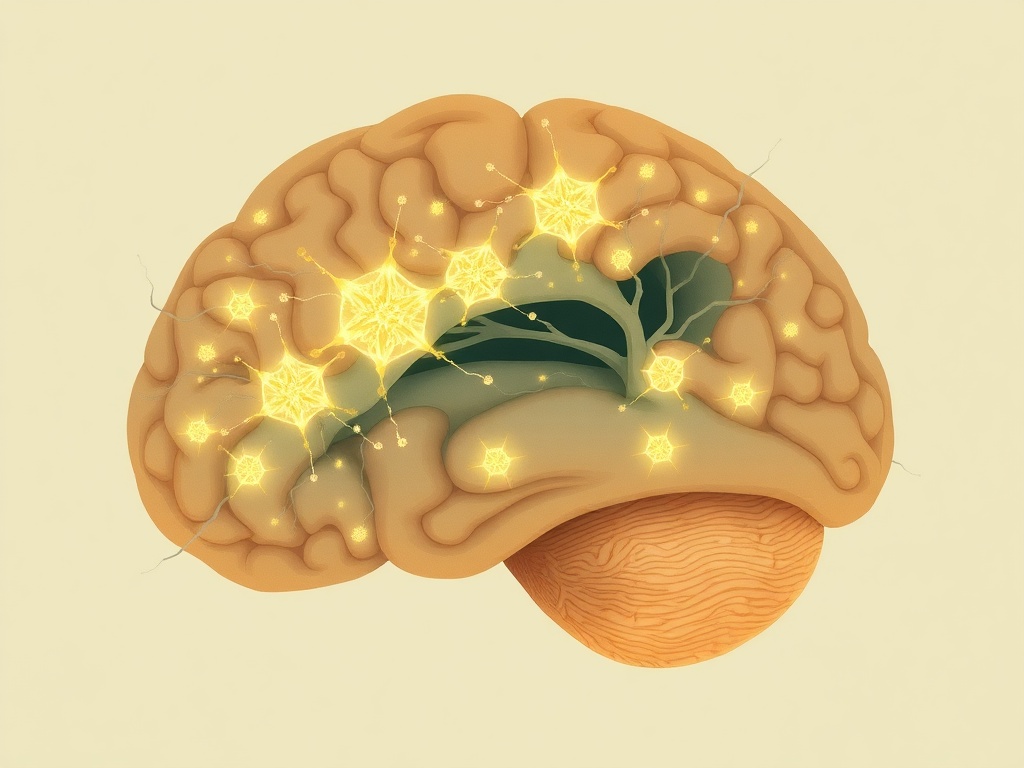
How memory actually forms at the cellular level remains one of neuroscience's most consequential open questions — and the answer has implications for understanding cognitive decline, Alzheimer's disease, and why some brains remain sharp far longer than others. New findings from PNAS challenge the long-held assumption that synaptic plasticity in the hippocampus operates within isolated, anatomically defined subregions.
The research documents a previously unrecognized form of metaplasticity — the capacity of synapses to modulate their own future plasticity based on prior activity — that travels from hippocampal area CA1 across the hippocampal fissure into the dentate gyrus (DG). This transregional signaling was found to be astrocyte-dependent, meaning that glial cells, not neurons alone, orchestrate this long-distance communication. The pathway appears to operate in addition to established canonical circuits, representing a parallel layer of hippocampal coordination not previously accounted for in standard connectome models.
This finding is potentially paradigm-shifting for several reasons. Astrocytes have historically been cast as passive support cells, but a growing body of evidence over the past decade has repositioned them as active participants in synaptic regulation, memory encoding, and network-level brain function. Implicating astrocytes in transregional metaplasticity adds significant weight to that repositioning. From a longevity and brain health perspective, the CA1-to-DG axis is critically important: CA1 is among the earliest hippocampal subfields damaged in Alzheimer's disease, while the dentate gyrus is a primary site of adult neurogenesis. A glial signaling bridge between them could mean that early CA1 dysfunction propagates plasticity impairment into a neurogenic zone, potentially accelerating cognitive decline. Key limitations apply: the current study appears to establish the phenomenon mechanistically, likely in animal models or ex vivo preparations, and translational relevance in aging human brains requires further investigation. Still, this is a genuinely incremental-to-significant advance in understanding hippocampal architecture.