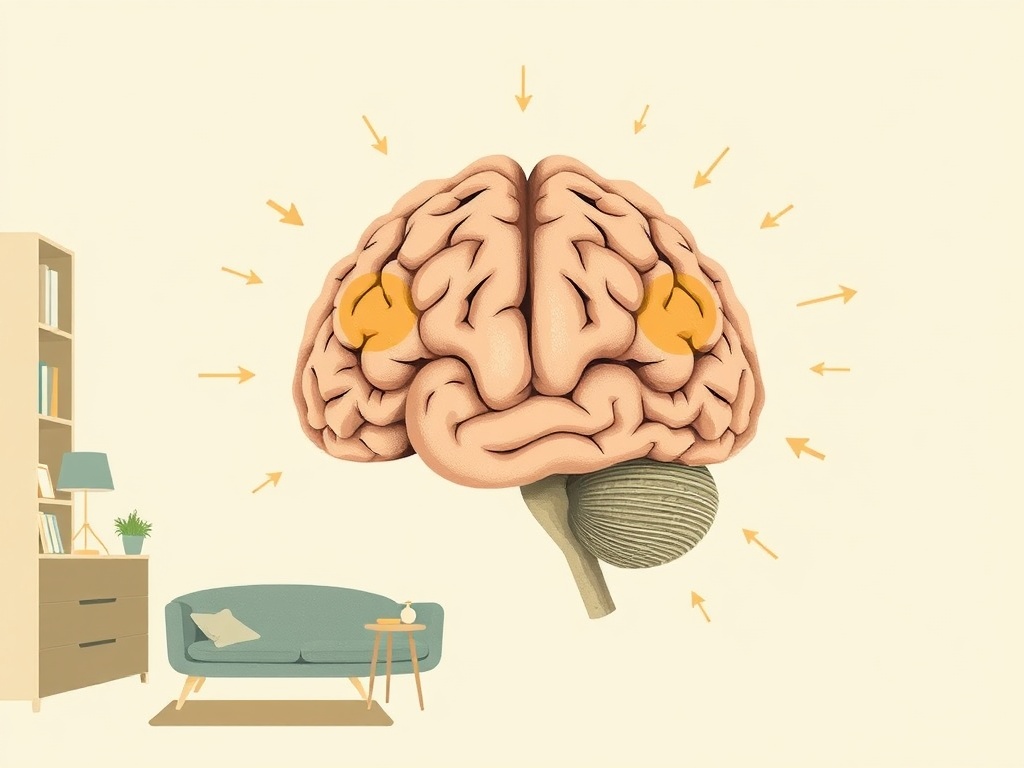
For anyone navigating a familiar room, street, or workplace, the brain quietly performs a remarkable feat: it uses stored memories to pre-direct attention toward objects and locations before conscious perception even registers them. When this memory-attention link breaks down — as it does in hippocampal sclerosis — the consequences for daily functioning can be profound. New findings from PNAS reveal that the severity of this breakdown depends critically on which side of the hippocampus is damaged.
The study examined how structural integrity of the hippocampus correlates with performance on memory-guided attention tasks — the ability to use long-term environmental knowledge to anticipate where relevant stimuli will appear. Crucially, the relationship between hippocampal tissue health and attentional guidance was lateralized: left-sided versus right-sided hippocampal sclerosis produced distinctly different patterns of covariation, suggesting the two hippocampi contribute asymmetrically to this cognitive function rather than serving identical roles in memory-attention integration.
This lateralization finding carries meaningful implications beyond epilepsy research. The hippocampus has long been conceptualized primarily as a memory structure, but accumulating evidence over the past decade increasingly frames it as a predictive processing hub — one that generates anticipatory representations to guide perception. This study adds anatomical specificity to that framework, suggesting the left and right hippocampi may specialize in different aspects of environmental prediction or attentional control. For clinicians working with temporal lobe epilepsy patients, the findings argue for side-specific cognitive assessment rather than treating hippocampal damage as a uniform deficit. Key limitations include the inherent cross-sectional nature of structural neuroimaging correlations, which cannot confirm causality, and the specialized patient population, which may limit generalizability to age-related hippocampal atrophy or other forms of medial temporal lobe pathology common in older adults.